7 AI Search Visibility Tools Marketing Agencies Should Know in 2026

As we move into 2026, marketing agencies are facing a new kind of visibility challenge. Clients are no longer only asking where they rank on Google — they’re asking why AI tools like ChatGPT, Gemini, and Perplexity recommend competitors instead.
This shift has given rise to AI Search Visibility and Generative Engine Optimization (GEO) — the practice of understanding how AI systems reference, cite, and describe brands inside generated answers.
To support this new workflow, a wave of specialized tools has emerged. These platforms don’t replace SEO tools; instead, they help agencies track, analyze, and influence how AI engines interpret brands.
Below is a curated list of seven AI search visibility tools agencies should be aware of in 2026 — focusing only on platforms built specifically for LLM visibility, citations, and generative search insights.
What to Look for in an AI Search Visibility Tool
Before comparing tools, agencies should evaluate platforms using three core criteria:
1. Multi-Engine Coverage
Does the tool monitor visibility across ChatGPT, Gemini, Perplexity, and AI Overviews?
2. Visibility Depth
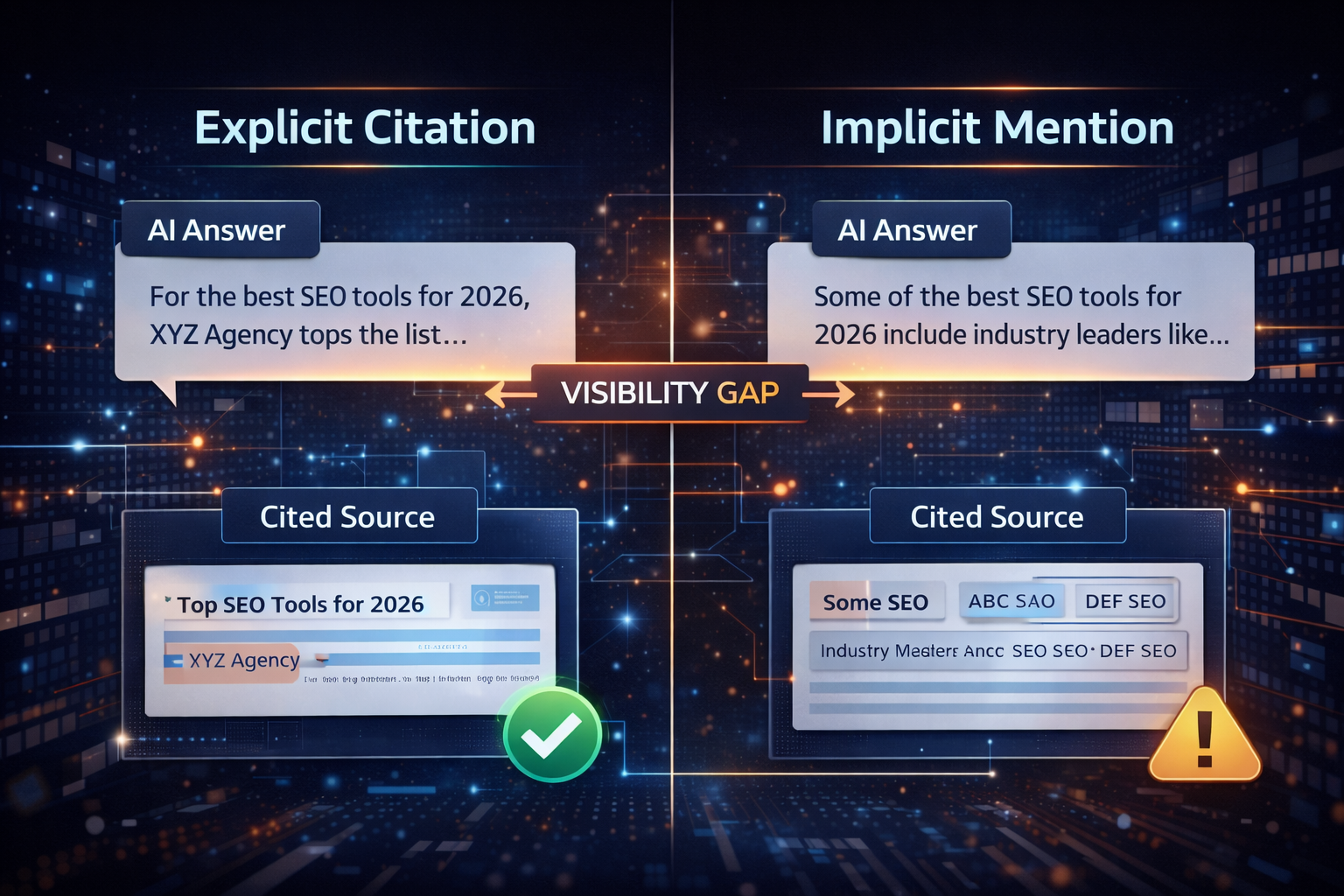
Can it distinguish between explicit citations and implicit mentions coming from third-party pages?
3. Actionability
Does it help teams move from insight to execution — content, outreach, or strategy?
The 7 AI Search Visibility Tools Agencies Are Comparing in 2026
1. Profound AI
Category: LLM Brand Monitoring
Best For: Agencies auditing brand presence inside AI answers
Profound AI focuses on monitoring how brands appear in AI-generated responses, primarily across conversational interfaces like ChatGPT. Its core value lies in helping agencies understand whether a client is referenced at all, and how those references change based on prompt phrasing.
How Agencies Use It
Agencies typically use Profound AI during discovery and reporting phases:
Monitoring brand presence:
Teams test recurring prompts to see whether a client appears in AI answers and how that presence shifts over time or across different wording.
Baseline visibility audits:
Profound is often used to establish an initial “AI visibility baseline” before content or PR efforts begin, helping agencies benchmark improvement later.
Strengths & Limits
Strengths
- Simple visibility checks across AI responses
- Useful for early-stage AI presence audits
- Prompt-level comparison over time
Limits
- No outreach or mention recovery workflows
- No content creation or citation guidance tied to queries
- Limited historical depth compared to GEO-focused platforms
2. Wellows
Category: AI Search Visibility & GEO Intelligence
Best For: Marketing agencies managing content, PR, and AI visibility together
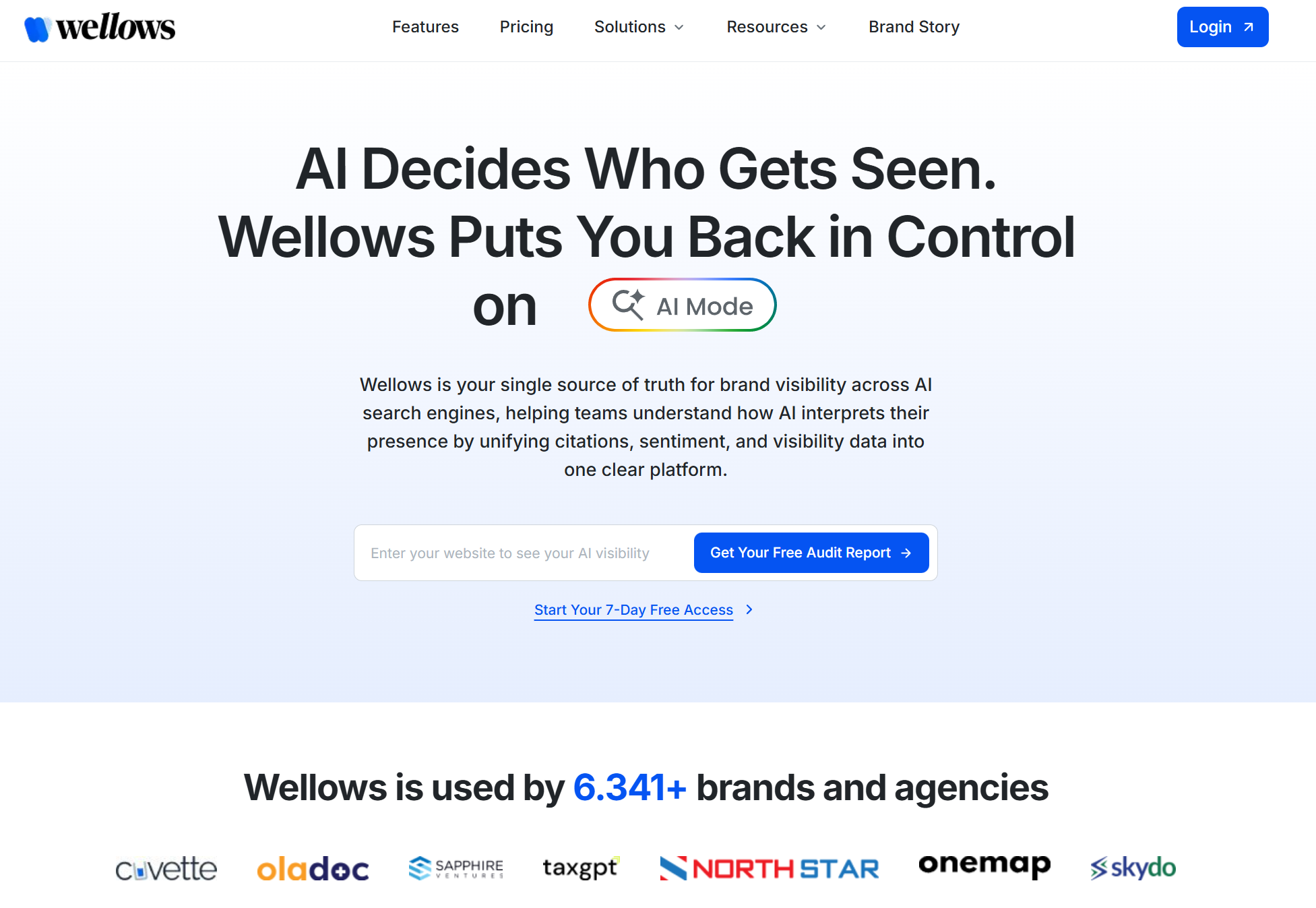
Wellows is built to help agencies understand how and why brands appear inside AI-generated answers — across ChatGPT, Gemini, Perplexity, and Google AI Overviews. Instead of treating AI visibility as a static snapshot, it tracks how citations and mentions evolve over time as LLMs update.
How Agencies Use It
Agencies typically use Wellows in two distinct workflows:
- Winning missed implicit mentions:
Wellows identifies third-party pages (reviews, guides, listicles, insights) that AI models cite — where competitors are mentioned but the client is not. Outreach support then helps agencies recover those missed mentions through verified publisher contacts and structured outreach. - Winning explicit citations:
Wellows surfaces real user queries being answered by LLMs where competitors are named explicitly. Its AI writing assistant helps agencies create content aligned to those exact queries, structured so AI engines can clearly parse and cite it.
Together, these workflows allow agencies to influence both what AI learns from and who AI names.
Strengths & Limits
Strengths
- Clear separation of explicit citations vs. implicit mentions
- Historical visibility tracking across LLM updates
- Outreach support tied directly to AI-cited sources
- Content guidance based on real LLM queries
Limits
- Focused on AI search visibility, not general social or brand listening
3. PromptWatch
Category: LLM Prompt Monitoring & Response Tracking
Best For: Agencies tracking how prompts influence AI outputs
PromptWatch is designed to help teams observe how large language models respond to different prompt structures over time. Rather than focusing on brand authority or citations, it emphasizes prompt experimentation and response consistency.
How Agencies Use It
Agencies typically use PromptWatch for experimentation and diagnostics:
Prompt behavior analysis:
Teams test how small changes in prompt phrasing alter AI responses, useful for understanding volatility and prompt sensitivity.
Output comparison over time:
Agencies track whether responses remain stable or drift after model updates.
Strengths & Limits
Strengths
- Useful for prompt testing and experimentation
- Tracks response variation across time
- Helpful for internal AI research workflows
Limits
- No citation or mention tracking
- No competitor visibility mapping
- Not designed for outreach or content strategy
4. Scrunch AI
Category: Brand Narrative & AI Presence Analysis
Best For: Agencies auditing how brands are described by AI models
Scrunch AI focuses on how AI systems describe brands in narrative form. It helps agencies understand tone, framing, and consistency across AI-generated answers rather than citation mechanics.
How Agencies Use It
Agencies use Scrunch primarily for messaging and reputation analysis:
Brand narrative audits:
Teams evaluate how AI summarizes a brand’s positioning, strengths, and weaknesses.
Sentiment consistency checks:
Scrunch highlights whether descriptions vary across prompts or engines.
Strengths & Limits
Strengths
- Strong narrative and tone analysis
- Useful for brand messaging reviews
- Simple sentiment visibility
Limits
- No visibility gap detection
- No outreach or recovery workflows
- Limited insight into why AI sources certain content
5. Xfunnel AI
Category: AI Search Funnel & Conversion Insights
Best For: Agencies linking AI discovery to downstream conversions
Xfunnel focuses on how AI-driven discovery impacts funnel performance. It connects AI search touchpoints with lead and conversion data rather than citation mechanics.
How Agencies Use It
Agencies typically apply Xfunnel post-discovery:
AI-assisted funnel attribution:
Teams analyze how AI mentions contribute to traffic or conversions.
Performance reporting:
Useful for showing downstream impact after AI exposure.
Strengths & Limits
Strengths
- Connects AI discovery to conversion metrics
- Useful for ROI-focused reporting
- Complements attribution models
Limits
- Does not track AI citations directly
- No visibility gap or mention recovery
- Limited use for early-stage GEO strategy
6. Peec AI
Category: AI Search Performance Tracking
Best For: Agencies monitoring AI-generated answers at scale
Peec AI tracks AI-generated responses across predefined prompts and topics. It is primarily used to understand frequency and presence, not influence.
How Agencies Use It
Agencies rely on Peec for monitoring:
Answer tracking:
Teams observe whether a brand appears across repeated AI answers.
Trend monitoring:
Useful for spotting sudden drops or spikes in visibility.
Strengths & Limits
Strengths
- Scalable monitoring across prompts
- Simple visibility trend tracking
- Useful for alerting
Limits
- No actionable guidance to fix gaps
- No outreach or content workflows
- Limited competitive context
7. BrandRank AI
Category: AI Brand Monitoring & Reporting
Best For: Agencies producing executive-level AI visibility reports
BrandRank AI is positioned as a reporting layer for AI visibility. It focuses on summarizing presence and rankings rather than explaining drivers.
How Agencies Use It
Agencies mainly use BrandRank for reporting:
Client reporting:
High-level visibility summaries for stakeholders.
Brand benchmarking:
Basic comparison across competitors.
Strengths & Limits
Strengths
- Clear executive dashboards
- Simple benchmarking visuals
- Easy client reporting
Limits
- Limited insight into citation sources
- No recovery or optimization workflows
- Not built for GEO execution
Sponsored Post. Check out our Partner Options at https://best-ai.org/partner
Recommended AI tools

DeepSeek
Conversational AI
Efficient open-weight AI models for advanced reasoning and research

n8n
Productivity & Collaboration
Open-source workflow automation with native AI

Notebook LLM
Productivity & Collaboration
Turn complexity into clarity with your AI-powered research and thinking partner

JanitorAI
Conversational AI
Create, share, and roleplay with fully customizable AI characters—your stories, your rules.
AutoGPT
Productivity & Collaboration
Build, deploy, and manage autonomous AI agents – automate anything, effortlessly.

Apify
Data Analytics
Automate Anything
About the Author
BitAutor UG (haftungsbeschränkt) is the German software development company behind Best-AI.org. The editorial team covers AI industry news, product launches, and practical insights from the AI ecosystem.
More from BitAutorWas this article helpful?
Found outdated info or have suggestions? Send us a note.