AI Tools for Software Developers
Explore 1271 curated AI tools for Software Developers, organized around real workflows, selection criteria, and practical adoption risks.
Modern software teams rely on AI copilots, code search, and automated testing to ship faster without sacrificing reliability. These tools remove repetitive toil, surface architecture risks, and document decisions so engineers can focus on the hard problems.
Frameworks, SDKs, and cloud services change weekly. Without AI augmentation, keeping codebases current consumes the same time that should drive product value. AI pair programming, static analysis, and doc bots make continuous delivery achievable for lean teams.


Community leaders
ChatGPT · Perplexity · Claude
Start with your workflow
Pick a task to open an AI-assisted recommendation prompt, then compare tools once you have a shortlist.
boilerplate services, typed clients, and unit tests...
Generate boilerplate services, typed clients, and unit tests while keeping architecture conventions intact.
Ask AI FinderSummarize sprawling code paths before refactors, in...
Summarize sprawling code paths before refactors, including related tickets, PRs, and incident history.
Ask AI Findermigration playbooks—framework upgrades, dependency ...
Automate migration playbooks—framework upgrades, dependency bumps, or API version changes.
Ask AI FinderDeploy chat-based runbooks that translate on-call a...
Deploy chat-based runbooks that translate on-call alerts into actionable remediation steps.
Ask AI FinderShowing 12 of 1,271 AI tools for Software Developers

ChatGPT
AI research, productivity, and conversation—smarter thinking, deeper insights.
ChatGPT is an AI chatbot designed for everyday use, assisting users in obtaining answers, finding inspiration, and boosting productivity. It enables interaction with an advanced AI to explore ideas, s
Perplexity
Clear answers from reliable sources, powered by AI.
Perplexity is an AI-powered answer engine that delivers real-time, source-cited responses by combining advanced language models with live web search. Key features include Deep Research for comprehensive reports, Copilot for guided exploration, Perplexity Labs for interactive reports, data analysis, code execution, and visualizations (since May 2025), Comet Browser, specialized focus modes (Academic, News, YouTube, Web, Pro-Search, Reasoning), multimodal processing (text, images, videos, documents, file uploads), collaborative Spaces, Shopping Hub, Finance tools, and integrated browser. Accessible via web and mobile apps with free and Pro/Enterprise plans.

Claude
Your trusted AI collaborator for coding, research, productivity, and enterprise challenges
Claude is a conversational AI, code assistance, and productivity solution for professionals and teams. It offers advanced reasoning capabilities, supports long-context workflows, provides safe agentic automation, and includes enterprise-grade security and governance features.
The AI that actually does things.
OpenClaw — Personal AI Assistant is openClaw is an AI personal assistant that automates tasks across platforms. It's designed for individuals seeking to delegate routine tasks. Key differentiators include its open-source nature and on-premise hosting. Category: Productivity & Collaboration, Code Assistance. Topics: ...
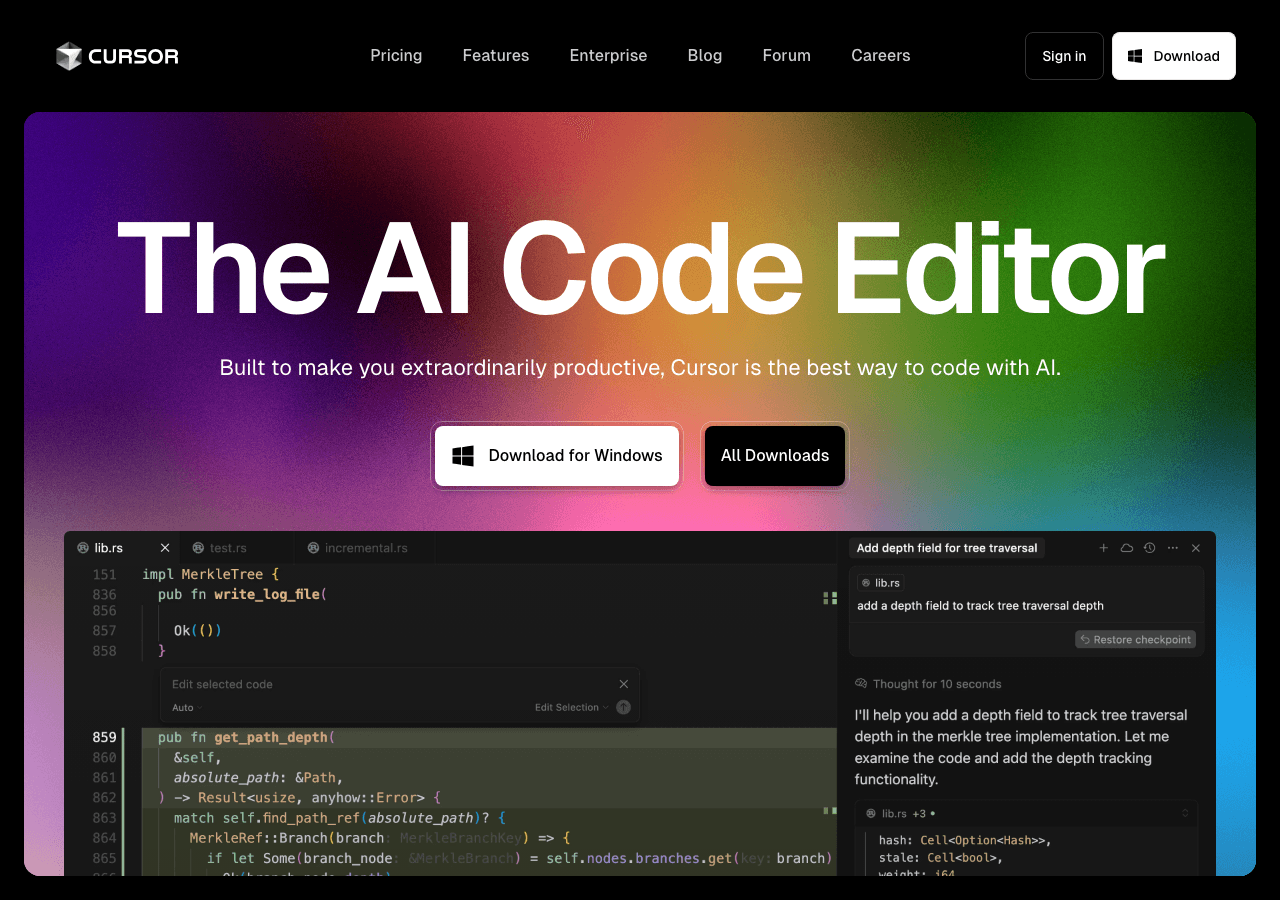
Cursor
The AI code editor that understands your entire codebase
Cursor is an AI-first code editor and IDE, forked from VS Code, with deeply integrated AI for intelligent code generation, refactoring, debugging, context-aware codebase chat, advanced tab autocomplete with multi-line predictions, Composer mode for multi-file edits, Agent mode with planning and PR workflows, Plan Mode, Rules, Slash Commands, Browser control, Hooks, Background Agents, own Composer model, support for models like GPT-4o, Claude 3.5 Sonnet, Gemini, xAI, image support, web search, customizable rules, full codebase understanding, real-time suggestions, AI Code Review, Instant Grep, and visual DOM editing—maximizing developer productivity.
DeepSeek
Efficient open-weight AI models for advanced reasoning and research
DeepSeek is a Chinese AI company founded in 2023 by Liang Wenfeng in Hangzhou, backed by High-Flyer hedge fund. It develops efficient open-weight large language models like DeepSeek-R1 (Jan 2025), DeepSeek-V3 (Dec 2024), and DeepSeek-V2, excelling in reasoning, multilingual tasks, and cost-effective training/inference despite US chip restrictions. Models use self-learning and reinforcement learning for competitive performance with fewer resources. All models and research are open-source, accessible via web, API, and apps. Note: Data collection (chats, files) sent to China servers raises GDPR/privacy concerns.
Google Antigravity - Build the new way
Google Antigravity - Build the new way IDE LIKE COURSOR AND WINDSURF
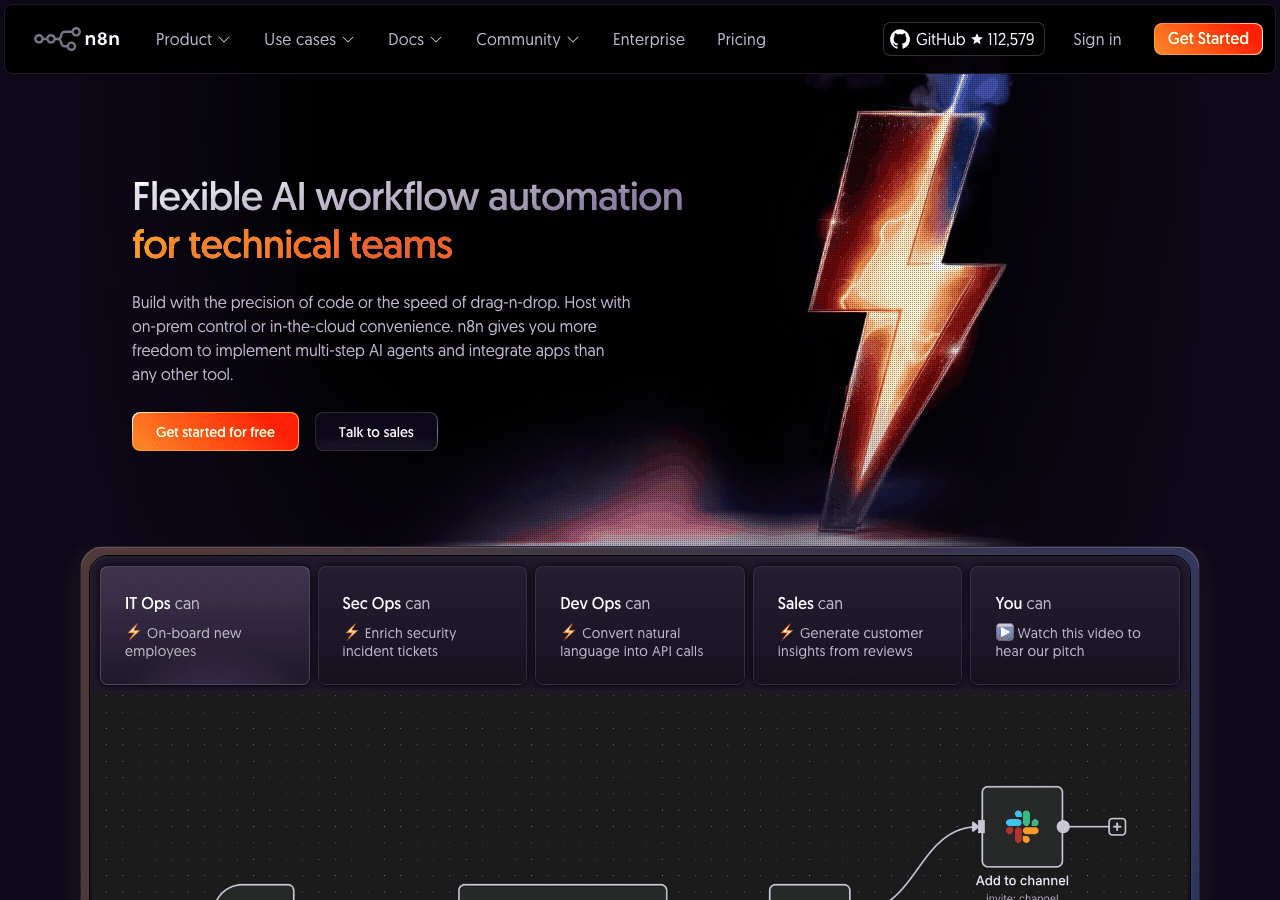
n8n
Open-source workflow automation with native AI
n8n is a flexible, open-source workflow automation platform for technical teams. It features a visual drag-and-drop editor with JavaScript/Python code nodes, 500+ integrations, 1700+ community templates, self-hosting, enterprise security (RBAC, SSO, SAML, LDAP, audit logs), native AI workflows with agents supporting OpenAI, Anthropic Claude, Google Gemini, Hugging Face, Langchain-based multi-agent systems, RAG, advanced debugging (inline logs, data replay), real-time visualization, performance insights, Git control, and scalability up to 220 executions/second. Version 2.0 adds autosave, modern canvas, and optimizations.

Tomorrow’s editor, today. The first agent-powered IDE built for developer flow.
Windsurf is an AI-native, agentic IDE (formerly Codeium) for developers, featuring Cascade for whole-codebase understanding with workflow rules in .windsurfrules, multi-file refactoring, automated cleanup, TypeScript error fixing, Supercomplete intent-aware autocomplete, Inline AI, image-to-code, live editor previews, Windsurf Tab for auto-imports and package suggestions, one-click deployments, AI terminal commands, Windsurf Browser with AI integration, web search, Figma integration, extensive model support (Claude 3.5 Sonnet, GPT-5-Codex, Gemini), privacy-first policies, VS Code/JetBrains plugins, and cross-platform compatibility (Mac, Windows, Linux) to maximize productivity via agentic automation and testable code changes.
Grok
Your cosmic AI guide for real-time discovery and creation
xAI builds Grok, an AI chatbot with voice chat, image and video generation, real-time search, and advanced reasoning. Try Grok at grok.com.
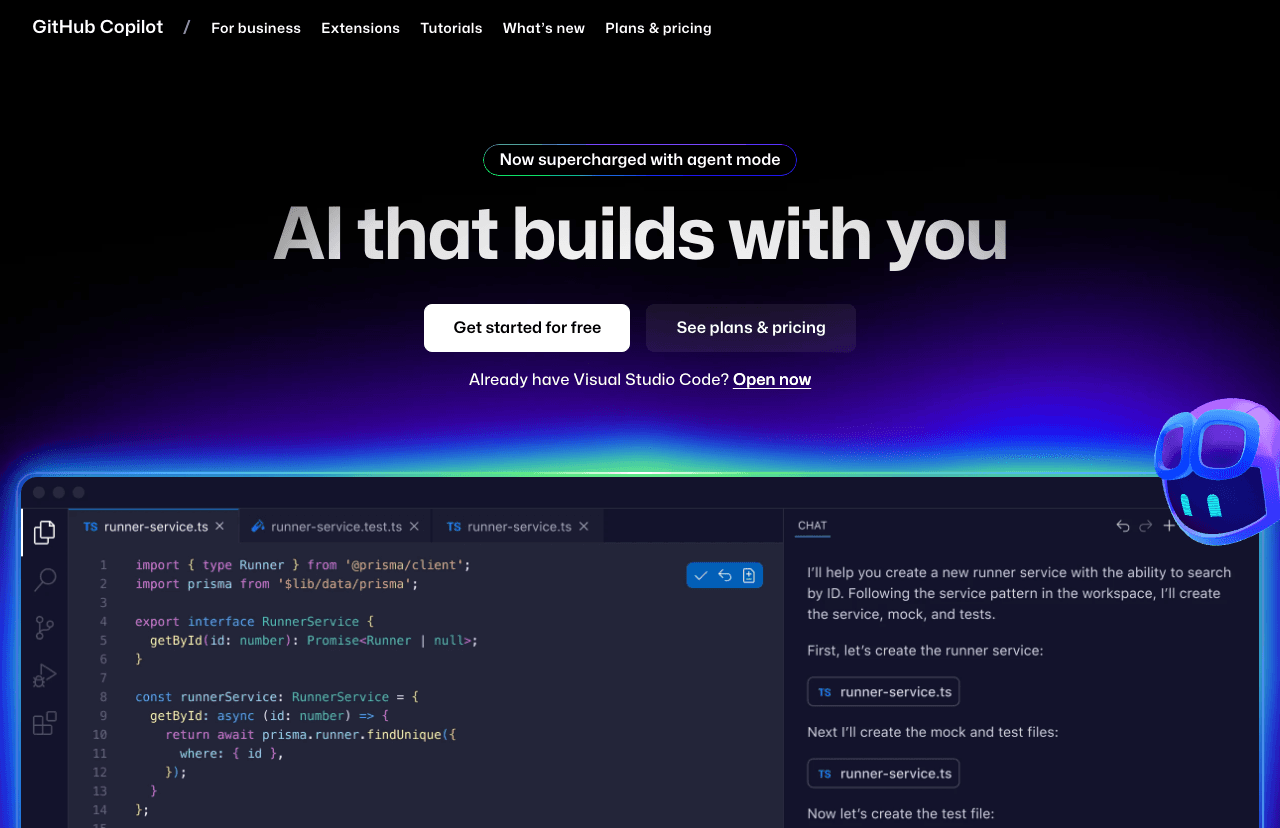
Your AI pair programmer and autonomous coding agent
GitHub Copilot is an AI-powered coding assistant and autonomous agent that integrates directly in IDEs (VS Code, Visual Studio, JetBrains, Xcode, Eclipse, Vim/Neovim) and the cloud. It provides code completions, next edit predictions, inline chat, multi-file editing, intelligent actions for tests/docs/fixes, and agent mode for handling issues, pull requests, refactoring, app modernization (.NET/Java), error fixing, test coverage, and multi-step workflows. New 2025 features include Copilot Free tier, enhanced agent with MCP integration, custom agents for workflows (CI/CD, security), open-sourced chat extension, and support for 15M+ developers.[1][2][3][4][5][6]
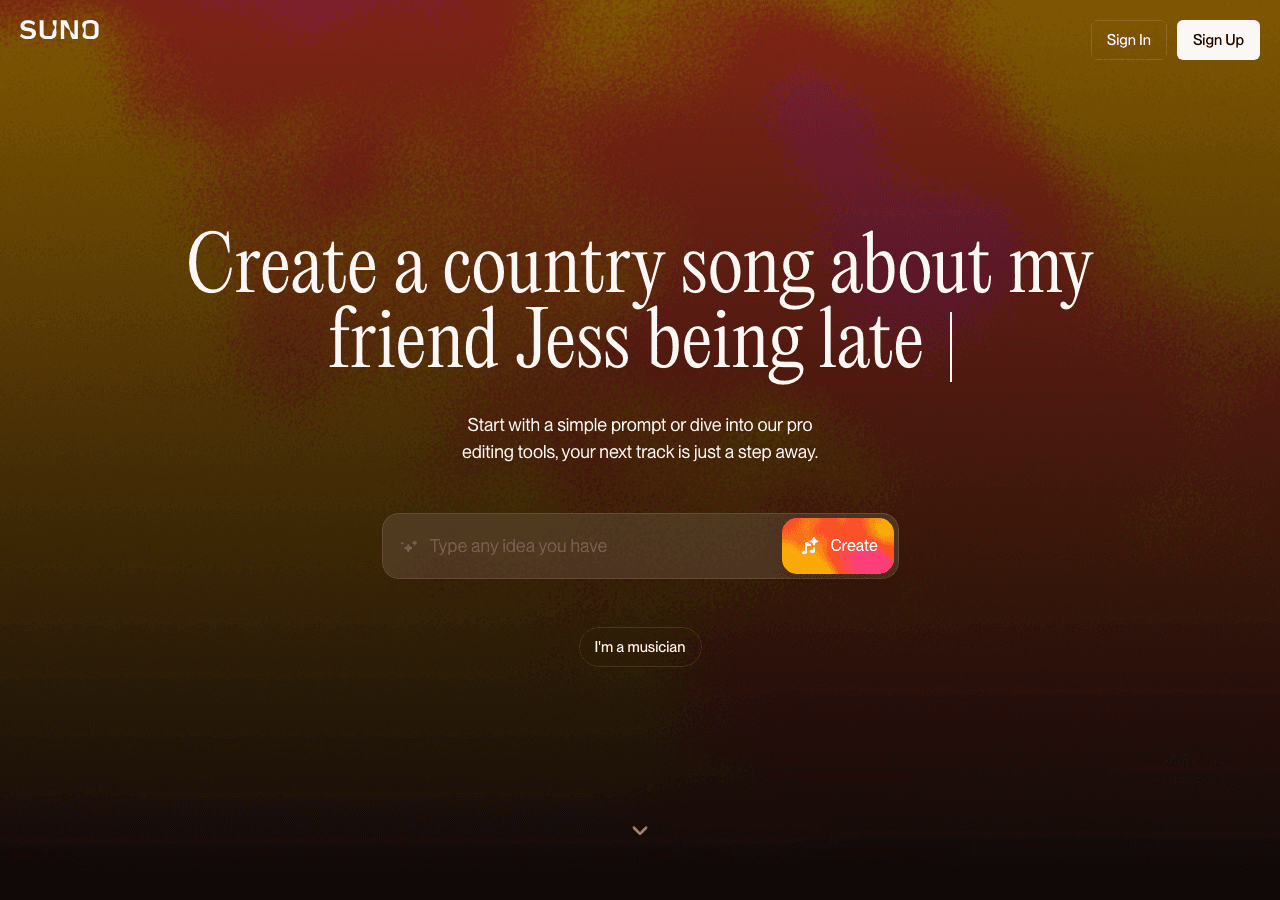
Suno AI
Empowering Your Data with AI
AI-powered music creation platform that enables users to generate original songs and music tracks from text descriptions, leveraging advanced models for dynamic audio, customizable features, and instant downloads—no musical experience required.
Not seeing the right fit for Software Developers?
Describe your exact workflow and let the AI finder suggest tools beyond this shortlist.
Explore AI tool categories
Compare finalists after your shortlist
Once you know the workflow, use focused comparisons and related code assistance tools to make the final call.
vs
Claude vs Cursor
vs
Claude vs Google Antigravity
vs
Claude vs Windsurf (ex Codium)


FAQ
What are common AI workflows for Software Developers?
Generate boilerplate services, typed clients, and unit tests while keeping architecture conventions intact. Summarize sprawling code paths before refactors, including related tickets, PRs, and incident history. Automate migration playbooks—framework upgrades, dependency bumps, or API version changes. Deploy chat-based runbooks that translate on-call alerts into actionable remediation steps.
How do I choose the right AI tool for Software Developers?
Strong IDE support (VS Code, JetBrains, Vim) with low-latency completions and inline documentation. Enterprise-grade privacy controls: on-prem options, zero data retention, SOC 2 / ISO 27001 coverage. Integration depth with GitHub, GitLab, Jira, and CI/CD pipelines to keep suggestions context-aware. Transparent model behavior and guardrails to prevent insecure patterns or license violations.
Are there free options for Software Developers?
Yes—many vendors offer free tiers or generous trials. Confirm usage limits, export rights, and upgrade triggers so you can scale without hidden costs.
How should I compare pricing for Software Developers tools?
Normalize plans to your usage, including seats, limits, overages, required add-ons, and support tiers. Capture implementation and training costs so your business case reflects the full investment.
What due diligence is essential before choosing tools for Software Developers?
Over-reliance on AI snippets that introduce subtle bugs. Adopt “trust but verify”: require generated code to pass tests and peer review, and rotate prompts into shared libraries once validated. Keeping proprietary code bases private when using hosted copilots. Favor vendors offering self-hosting or secure VPC deployments so training never touches production code. Team divergence when each developer configures different AI assistants. Standardize prompts, style guides, and model settings across squads; capture best prompts in an internal playbook.
How do we roll AI out to the entire software developers team?
Pilot in one squad with strong testing discipline. Track velocity, defect rate, and time-to-recovery. Once confidence grows, roll out shared prompt libraries, code templates, and governance policies. Pair senior devs with juniors to mentor AI-assisted workflows.
Which metrics prove AI is delivering ROI?
Story cycle time before vs. after AI adoption. Escaped defect rate and mean time to recovery. Percentage of boilerplate generated automatically. PR review throughput without compromising quality.
Any advanced strategies once the basics are working?
Combine embeddings-based code search with your knowledge base to create a custom internal Copilot that understands proprietary frameworks and guidelines.
High-Impact Workflows You Can Automate Today
- Generate boilerplate services, typed clients, and unit tests while keeping architecture conventions intact.
- Summarize sprawling code paths before refactors, including related tickets, PRs, and incident history.
- Automate migration playbooks—framework upgrades, dependency bumps, or API version changes.
- Deploy chat-based runbooks that translate on-call alerts into actionable remediation steps.
Tool Selection Framework for Software Developers
Use this checklist when evaluating new platforms so every trial aligns with your workflow, governance, and budget realities:
- Strong IDE support (VS Code, JetBrains, Vim) with low-latency completions and inline documentation.
- Enterprise-grade privacy controls: on-prem options, zero data retention, SOC 2 / ISO 27001 coverage.
- Integration depth with GitHub, GitLab, Jira, and CI/CD pipelines to keep suggestions context-aware.
- Transparent model behavior and guardrails to prevent insecure patterns or license violations.
Challenges & Risk Mitigation
Over-reliance on AI snippets that introduce subtle bugs.
Keeping proprietary code bases private when using hosted copilots.
Team divergence when each developer configures different AI assistants.
Adoption & Change Management Playbook
Pilot in one squad with strong testing discipline. Track velocity, defect rate, and time-to-recovery. Once confidence grows, roll out shared prompt libraries, code templates, and governance policies. Pair senior devs with juniors to mentor AI-assisted workflows.
Success Metrics to Track
- Story cycle time before vs. after AI adoption.
- Escaped defect rate and mean time to recovery.
- Percentage of boilerplate generated automatically.
- PR review throughput without compromising quality.
Collaboration Tips & Advanced Strategies
- Host weekly “prompt dojo” sessions to share high-performing prompts and failure cases.
- Invite security and platform engineering to vet AI-generated configs or infrastructure code.
- Document lessons learned in architecture decision records so context travels across teams.
Pro move
Combine embeddings-based code search with your knowledge base to create a custom internal Copilot that understands proprietary frameworks and guidelines.