Autonomous AI Agents Combat Prompt Fatigue and SaaS Sprawl in Enterprise Workflows

The End of the Chat Window: Why the Enterprise is Shifting to Autonomous AI Workers
The enterprise has officially hit "prompt fatigue." Over the last two years, generative AI has been sold as the ultimate productivity hack. Yet, while Large Language Models (LLMs) have drastically accelerated how we brainstorm and draft text, the actual execution of daily B2B workflows remains stubbornly manual.
We are still trapped in the "copilot" paradigm. A copilot is helpful, but it still requires a human to fly the plane—copying, pasting, formatting, and aggressively context-switching between a dozen isolated applications just to get a single project over the finish line.
The next evolution of the enterprise workspace abandons the copilot model in favor of the autopilot. The transition from static chat wrappers to fully autonomous, multi-agent workflows is here. It is built for operators, creators, and business leaders who demand executable results, not just endless conversation.
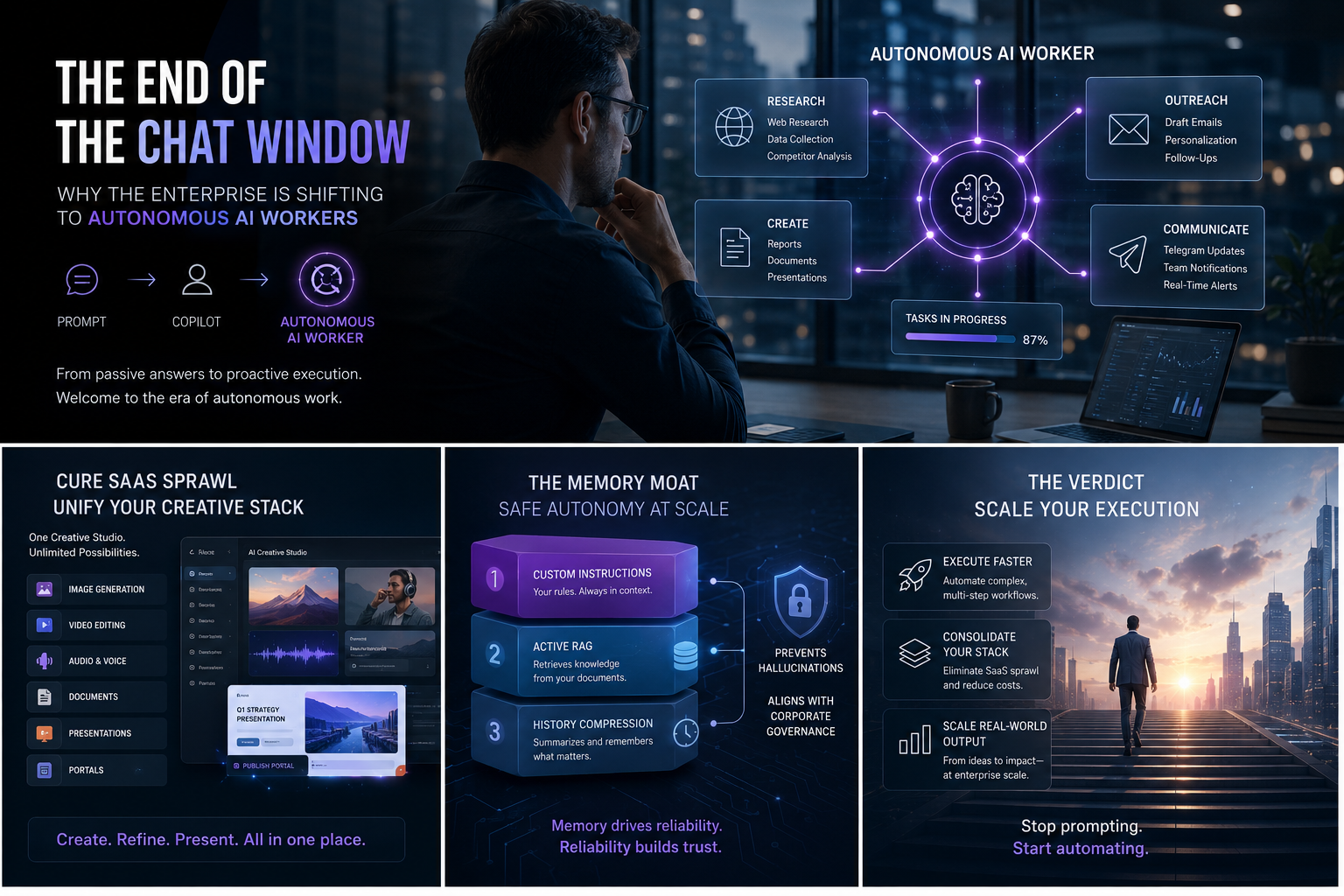
The Illusion of Productivity vs. Autonomous Execution
The fundamental flaw of the current AI ecosystem is its passivity. You ask a question, you get an answer, and the workflow abruptly stops until you intervene again.
The introduction of the Autonomous Agent fundamentally rewrites this operational rule. Imagine a system that doesn’t just outline a competitor analysis, but actively executes deep, multi-layered web research, compiles the raw data into a comprehensive executive report, drafts the outbound outreach emails, and proactively pushes real-time updates directly to your team's communication channels, such as Telegram.
By deploying an autonomous AI agent for business, teams can entirely offload highly repetitive, multi-step tasks. These agents operate autonomously in the background, managing scheduling, data synthesis, and follow-ups without requiring constant human hand-holding or micro-management.
Curing SaaS Sprawl: The Unified Media Engine
Autonomy isn't limited to administrative logic; it is completely redefining creative execution. Currently, corporate innovation is bottlenecked by severe "SaaS sprawl." Marketing and strategy teams are forced to juggle one subscription for image generation, another for audio, and a third for document synthesis. This fragmentation is a massive drain on both enterprise productivity and operational budgets.
The most advanced AI workspaces are solving this by consolidating these fragmented capabilities into a single Creative Studio. Innovators can now manipulate images, conceptualize rich media, and compose AI-generated music and voiceovers within one unified environment.
More importantly, these platforms bridge the critical gap between raw creation and client-ready presentation. Need to pitch a new concept to stakeholders? You no longer have to export your AI text to PowerPoint. Using integrated features like Presentations & Portals, users can instantly transform complex AI outputs and raw data into shareable, fully formatted slide decks or interactive mini-websites in seconds.
The Memory Moat: Safe Autonomy at Scale
None of this autonomy works if the AI suffers from "context amnesia." For an agent to execute a complex, multi-day workflow reliably, it must remember the strict rules of engagement. When an AI forgets previous prompts, it hallucinates—a risk the enterprise simply cannot afford.
This is exactly why the underlying infrastructure of an AI workspace matters. The integration of a Three-Tier Memory System—combining custom instructions, active RAG (Retrieval-Augmented Generation), and intelligent history compression—is the technical moat that makes autonomy safe. It ensures that your digital worker doesn't just remember what you said five minutes ago, but perfectly recalls the strategic nuances from a massive PDF uploaded three weeks prior. It actively prevents hallucinations and keeps autonomous outputs strictly aligned with corporate governance.

The Verdict: Scale Your Execution
The shift is undeniable: AI is no longer just a digital brainstorming buddy trapped in a browser tab. Through visionary platforms like AI Council Chat, AI has evolved into an autonomous digital workforce and a comprehensive creative suite.
It empowers teams to execute faster, consolidate their bloated tech stacks, and scale their real-world output like never before. The future belongs to organizations that stop prompting and start automating.
Recommended AI tools

OpenClaw AI Agent
Productivity & Collaboration
The AI that actually does things.

n8n
Productivity & Collaboration
Open-source workflow automation with native AI

GitHub Copilot
Code Assistance
Your AI pair programmer and autonomous coding agent

Notion AI
Productivity & Collaboration
The all-in-one AI workspace that takes notes, searches apps, and builds workflows where you work.

Google Cloud Vertex AI
Data Analytics
Gemini, Vertex AI, and AI infrastructure—everything you need to build and scale enterprise AI on Google Cloud.
AutoGPT
Productivity & Collaboration
Build, deploy, and manage autonomous AI agents – automate anything, effortlessly.
About the Author
BitAutor UG (haftungsbeschränkt) is the German software development company behind Best-AI.org. The editorial team covers AI industry news, product launches, and practical insights from the AI ecosystem.
More from BitAutorWas this article helpful?
Found outdated info or have suggestions? Send us a note.