General Intuition Aims for Robotics' 'ChatGPT Moment' with Video Game Data
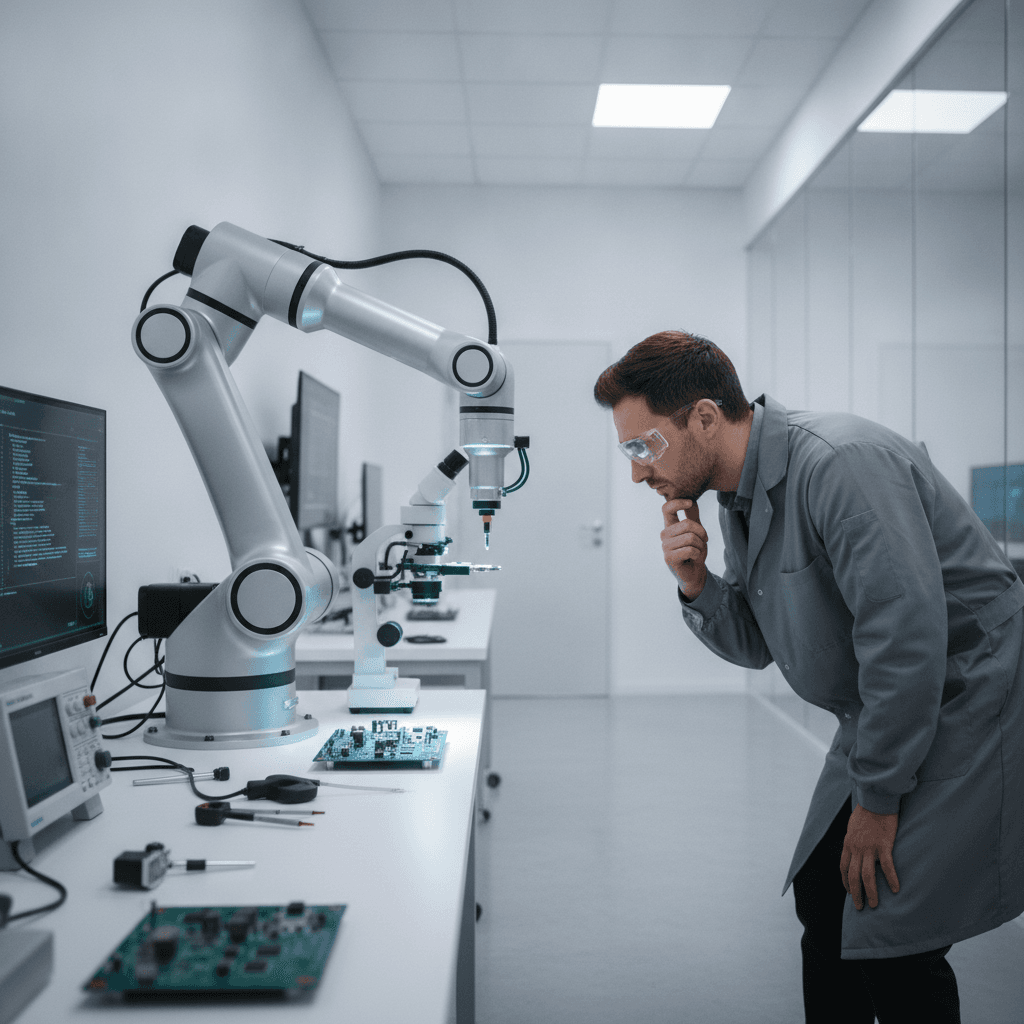
General Intuition's Vision for Robotics AI
General Intuition, a robotics AI startup, aims to revolutionize the embodied AI industry by comparing its general-purpose foundation models to the significant impact of ChatGPT on natural language processing. This approach directly contrasts with the current fragmented robotics landscape, where specialized models are typically required for each unique robot, environment, and task. For broader context, explore our AI News.
Pim de Witte, CEO of General Intuition, stated on July 8, 2026, that their company has developed a foundation model trained on millions of hours of video game data. This model is designed to teach robots reasoning about space, time, and physical interaction. The core idea is to use synthetic game-engine data to overcome the scarcity of real-world robotics data, which is a major bottleneck in the industry.
The 'ChatGPT Moment' for Robotics
The concept of a "ChatGPT moment" for robotics, as envisioned by General Intuition, refers to a point where a single, general-purpose model can drastically simplify the development and deployment of robotic applications. This mirrors the impact of large language models like GPT and ChatGPT on text-based AI, where a foundational model can be fine-tuned for various tasks with minimal additional data.
De Witte claims that their general model could reduce the real-world data needed for fine-tuning a robot to "a few minutes." This would be a substantial improvement over current methods, which often demand extensive real-world data collection and model training for each specific application. The company suggests this could make building robotics applications significantly cheaper and faster, akin to the significant effect of GPT-3 on language tasks.
Comparing General Intuition's Approach to GPT-3 and ChatGPT
General Intuition's strategy draws parallels with the development of large language models such as GPT-3 and ChatGPT. These models demonstrated that training on vast datasets could lead to general capabilities that are then adaptable to a wide range of specific applications. The key distinction lies in the domain: while GPT-3 and ChatGPT operate in the realm of text and language, General Intuition is applying a similar foundational model concept to physical interaction and robotics.
Feature Comparison: General Intuition vs. GPT-3/ChatGPT
| Feature | General Intuition's Foundation Model | GPT-3 / ChatGPT |
|---|---|---|
| Primary Domain | Robotics, physical interaction | Natural language processing |
| Training Data Source | Millions of hours of video game data | Internet text data |
| Core Capability | Reasoning about space, time, physical interaction | Language understanding and generation |
| Impact on Development | Aims to reduce real-world fine-tuning data to "a few minutes" | Enabled broad language application development with fine-tuning |
Strengths and Limitations of General Intuition's Model
Strengths
- Reduced Data Dependency: By utilizing synthetic video game data, General Intuition aims to bypass the scarcity of real-world robotics data, which is a significant cost and time factor in current robotics development.
- Generalization Potential: A single foundation model could serve as a base for various robotic tasks and environments, potentially lowering the barrier to entry for deploying capable robots.
- Efficiency: The promise of fine-tuning with only "a few minutes" of real-world data suggests a much faster development cycle for new robotic applications.
Limitations
- Real-World Transferability: While video game data teaches reasoning, the direct transferability of these learned behaviors to the complexities and unpredictability of the real physical world remains a critical challenge for any synthetic data approach.
- Scope of Application: The current focus on reasoning about space, time, and physical interaction, while foundational, may still require significant domain-specific fine-tuning for highly specialized or nuanced robotic tasks.
Best-Fit Use Cases
General Intuition's approach is particularly well-suited for scenarios where the cost and time associated with collecting real-world robotics data are prohibitive. Industries looking to rapidly prototype and deploy robots for a variety of tasks, or those operating in environments where real-world data collection is dangerous or impractical, could benefit significantly. The model's ability to teach reasoning about space and physical interaction makes it potentially valuable for tasks requiring navigation, object manipulation, and interaction within dynamic environments.
Conclusion
General Intuition's pursuit of a general-purpose foundation model for robotics, trained on video game data, represents a bold attempt to replicate the success of large language models like GPT-3 and ChatGPT in a new domain. If successful, this approach could fundamentally alter how robotic systems are developed and deployed, making them more accessible and adaptable. The key will be demonstrating the model's ability to effectively bridge the gap between simulated environments and the complexities of real-world physical interaction, ultimately delivering on the promise of significantly reduced development times and costs for robotics applications.
Sources
- https://techcrunch.com/2026/07/08/this-startup-thinks-robotics-is-about-to-have-its-chatgpt-moment/
- Why world models are the next big thing in AI | The Verge
- A peek inside Physical Intelligence, the startup building Silicon Valley's buzziest robot brains | TechCrunch
- General Intuition in talks to raise $300M at around $2B valuation
- General Intuition lands $134M seed to teach agents spatial...
Recommended AI tools

Cyber Square Pro
Code Assistance
#1 AI & Robotics Platform for Schools

Apex.AI
Code Assistance
Software that moves.

Rerun
Data Analytics
Visualize, debug, and analyze your spatial and embodied AI data—effortlessly.

Cartwheel
3D Generation
Simplify Your Project Management

Covariant
Conversational AI
AI Robotics for Real-World Applications

Roboto
Data Analytics
Empowering teams to search, transform, and analyze multimodal data at scale
Was this article helpful?
Found outdated info or have suggestions? Send us a note.