Small AI Models vs. ChatGPT: Why Edge AI Delivers Life-Saving Services in Developing Nations
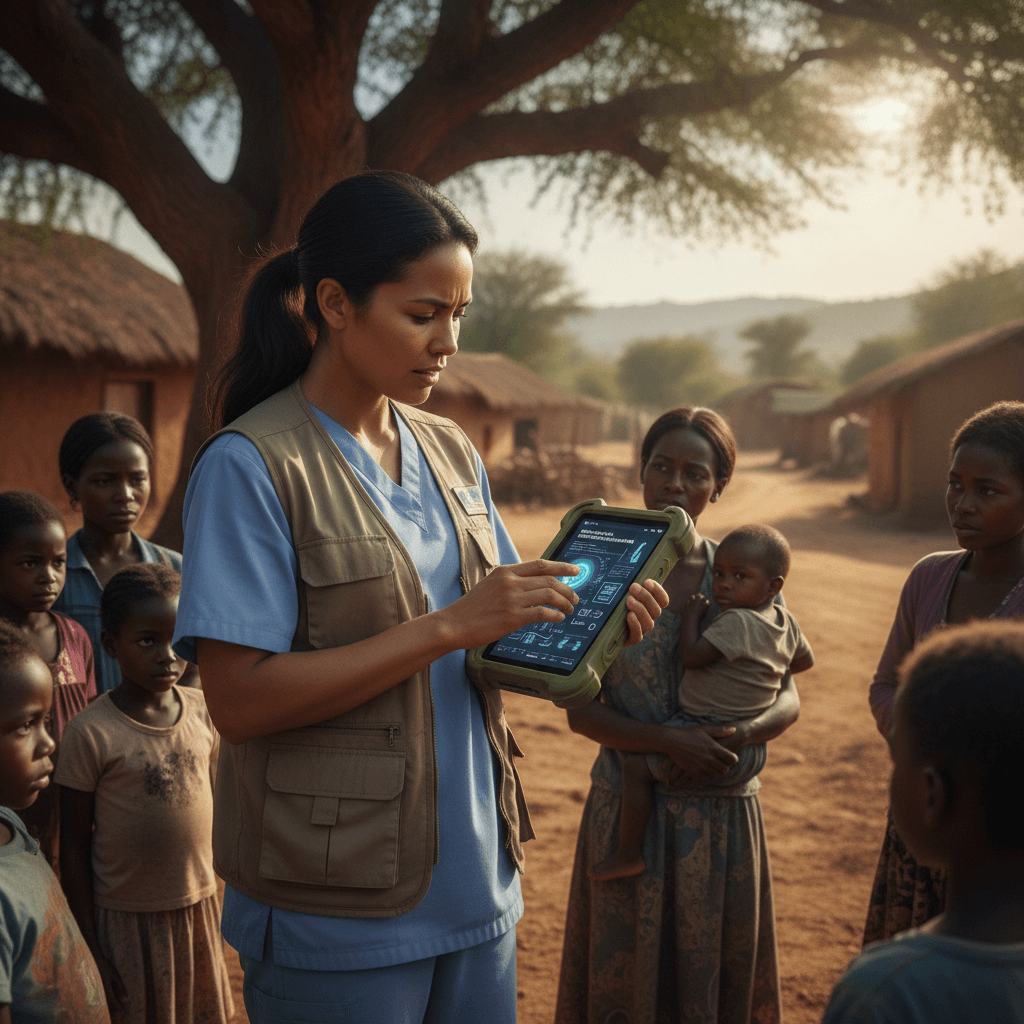
Small AI models, with at most a few billion parameters, are gaining traction worldwide as a practical alternative to massive large language models (LLMs) like ChatGPT, particularly for on-device applications without cloud connectivity. This comparison explores how these smaller, task-specific AI models are delivering life-saving services in healthcare, agriculture, and public safety, contrasting their accessibility and operational requirements with those of their larger counterparts. For broader context, explore our AI News.
Defining Small AI Models and Large Language Models
Small AI models are characterized by having at most a few billion parameters, enabling them to operate efficiently on edge devices such as smartphones, Raspberry Pis, Arduino boards, and drones. Their design allows for local processing without requiring continuous cloud connectivity. This contrasts sharply with large language models, which typically possess hundreds of billions or even trillions of parameters, necessitating substantial computational resources and cloud infrastructure for their operation.
Small AI Models: Strengths, Limitations, and Use Cases
Strengths: Small AI models excel in scenarios demanding on-device processing and independence from internet access. Their compact size and lower computational demands make them suitable for deployment in remote areas or environments with unreliable connectivity. They are often task-specific, leading to highly efficient and accurate performance within their defined scope. The creation of these models often involves techniques like pruning, distillation, and precision reduction to optimize their size and performance.
Limitations: While powerful for specific tasks, small AI models generally lack the broad, general-purpose conversational capabilities of larger LLMs. Their training data is typically more focused, limiting their ability to handle diverse queries or generate creative text across a wide range of topics.
Best-Fit Use Cases: Small AI models are proving significant in critical applications across various sectors. For instance, RxScanner utilizes a handheld spectrometer with a local AI model to identify counterfeit medications in Africa and Asia, providing real-time results. In India, a drone-based system employs small AI models to detect diseased cashew plants directly on the device. Other applications include identifying ant infestations in Uruguayan vineyards, detecting malaria-carrying mosquitoes, and powering portable electrocardiograms in rural Brazil. World Bank president Ajay Banga notably referred to small AI as "India's secret weapon" at Davos 2026, highlighting its potential for global impact.
ChatGPT and Large Language Models: Strengths, Limitations, and Use Cases
Strengths: ChatGPT and other large language models are renowned for their extensive general knowledge, advanced conversational abilities, and capacity to generate human-like text, translate languages, write different kinds of creative content, and answer your questions in an informative way. Their vast parameter counts allow them to understand and generate complex language patterns, making them versatile for a wide array of tasks requiring sophisticated language processing.
Limitations: The primary limitation of large language models is their reliance on significant computational power and cloud infrastructure. This dependency makes them less accessible in regions with limited internet access or where data privacy concerns necessitate on-device processing. Furthermore, the cost associated with running and accessing these models can be a barrier for many users, particularly in developing countries. As of November 2025, only 0.7% of internet users in the world's poorest countries had used ChatGPT.
Best-Fit Use Cases: Large language models are ideal for tasks requiring broad knowledge, creative text generation, complex problem-solving through natural language, and interactive conversational interfaces. They are widely used in customer service, content creation, education, and research where extensive data processing and nuanced language understanding are paramount.
Feature Comparison: Small AI Models vs. ChatGPT
Feature | Small AI Models | ChatGPT (Large Language Models) |
|---|---|---|
Parameter Count | At most a few billion | Hundreds of billions to trillions |
Operational Environment | On-device (phones, Raspberry Pis, drones) | Cloud-based (requires internet) |
Cloud Connectivity | Not required a cloud | is always Required |
Accessibility in Remote Areas | High | Low |
Task Specificity | High (often specialized) | Broad (general-purpose) |
The Global Impact and Future Outlook
The rise of small AI models signifies a strategic shift towards millions of precise, edge-deployed models rather than a few centralized giants. This decentralization of AI capabilities promises to democratize access to advanced technology, particularly in underserved regions. The ability of small, task-specific AI models to deliver life-saving services in healthcare, agriculture, and public safety underscores their critical role in global development.
The IEEE Spectrum has highlighted the growing importance of these models, noting their practical applications in pharmaceuticals and beyond. This trend suggests a future where AI is not just a cloud-based utility but an embedded, ubiquitous technology enhancing daily life and addressing specific local challenges worldwide.
Conclusion
The choice between small AI models and large language models like ChatGPT depends entirely on the specific application and available resources. Small AI models offer unparalleled accessibility and efficiency for edge computing and offline operations, making them invaluable for critical, localized tasks in resource-constrained environments. Conversely, large language models provide broad, sophisticated language processing capabilities, ideal for general-purpose applications requiring extensive knowledge and complex interactions. The increasing traction of small AI models globally indicates a future where diverse AI solutions cater to a wider range of needs, fostering innovation and inclusivity across the digital divide.
Sources
- https://github.com/attogram/small-models
- https://arxiv.org/html/2507.20859v1
- https://techcrunch.com/2021/07/20/rxall-grabs-3.15m-to-scale-its-drug-checking-and-counterfeiting-tech-across-africa
- https://spectrum.ieee.org/small-language-models-ai-pharmaceuticals
- https://www.worldbank.org/en/publication/dptr2025-ai-foundations
Recommended AI tools

Azure Machine Learning
Data Analytics
Enterprise-grade AI and ML, from data to deployment

Transformers
Conversational AI
State-of-the-art AI models for text, vision, audio, video & multimodal—open-source tools for everyone.

Erase.bg
Design
Automatically remove backgrounds in 5 seconds

Roboflow
Scientific Research
Computer vision tools for developers and enterprises

Ultralytics
Scientific Research
Accelerating AI for everyone

mnml.ai
Image Generation
The AI studio for architectural design and visualization
Was this article helpful?
Found outdated info or have suggestions? Send us a note.