AI Tools for Solo Founders
Build Your One-Person AI Stack
TL;DR:
As a solo founder, you don’t need a huge team to move fast—you need an AI stack that helps you validate ideas, build an MVP, ship marketing, and handle support with as little overhead as possible. This guide shows you which types of AI tools to combine into a lean one-person stack, and how to adopt them without drowning in complexity or subscription costs.

Academy review: July 6, 2026
Model names and capabilities change frequently. We use provider families (GPT, Claude, Gemini) in Academy copy — verify current tiers on provider sites or our LLM Model Family Guide.
For live model picks, cross-check with our Free vs Paid guide.
What's different for this role in 2026
One-person stacks in 2026 cap at ~5 tools with clear data boundaries. Founders win by automating research and drafts, not by subscribing to every new launch.
Stack snapshot (verify names & pricing before you buy)
Validate & research
GPT, Claude Sonnet, Gemini Pro, Perplexity, Claude for competitive scans
Build MVP
Cursor / v0 / Bolt.new-style builders, Supabase, Firebase
Marketing
Canva, Buffer AI, newsletter assistants
Support & ops
Intercom Fin, Notion AI, Zapier + LLM steps
Pitfalls to avoid in 2026
- Ten overlapping SaaS tools with unclear ROI
- Customer PII in consumer chatbots
- Outsourcing strategic decisions to unverified AI advice
Tool rankings change monthly — compare live options in our tool explorer or Free vs Paid guide.
Where this course fits
This guide: Solo founder stack
Lean four-layer stack: validate, build, market, operate — without team overhead.
Learn first (we do not repeat this here)
Go deeper after this course
- AI in Practice — Workflows and evaluation habits as you grow.
Founder context — July 2026 depth note
Solo stacks in 2026 stay under five paid tools with clear data boundaries. AI buys back hours on research, drafts, and ops — not strategic judgment or customer trust.
- Map which tasks are human-only (pricing, hiring, investor comms).
- Cap subscriptions; review ROI monthly against hours saved.
- Never paste customer PII or cap-table details into consumer chatbots.
Who this guide is for
If you're building a product as a one-person founder, this guide is for you. You might be validating your first startup idea next to a full-time job, running a small bootstrapped SaaS with a handful of paying customers, or operating a services business while you slowly productize your best offers.
In all of these cases you wear every hat: product, design, marketing, sales, and support. The right AI stack doesn't replace your judgment – it buys you back hours every week so you can spend more time on the parts that actually move the business.
Real Scenario: 11pm Crisis Mode
It's 11pm. Product launches tomorrow. Customer found a critical bug. Your developer quit last week. You're alone. Here's how AI saves you:
- Debug with Claude (5 min): Paste error logs → get root cause analysis
- Fix with GitHub Copilot (15 min): Generate patch → review → test
- Communicate with ChatGPT (10 min): Draft customer apology + status update
- Document with Notion AI (5 min): Update changelog + create postmortem
Time: 4 hours → 35 minutes. Launch happens on schedule. You sleep.
Stack layers — July 2026 depth note
Validate with GPT-class research assistants, build with agent-native IDEs, market with Canva-class tools, operate with lightweight automation — one tool per layer before you add more.
- Use Perplexity or Claude for competitive scans with cited sources.
- Prototype in Cursor/v0-class builders; keep architecture docs human-owned.
- Automate support drafts only with a human send button.
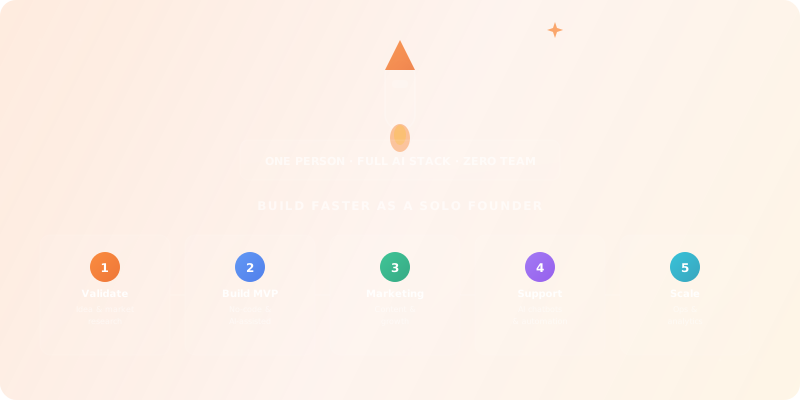
The solo founder AI stack at a glance
A practical way to think about AI for solo founders is to group your tools into four layers. You don’t need a dozen apps in each layer – one or two solid picks per layer are enough for a high-impact stack.
1. Idea & market research
Turn vague ideas into clear problem statements, scan competitors, and generate buyer personas without spending days in docs and spreadsheets.
2. Building & shipping
Code assistants, no-code builders, and documentation helpers so you can ship an MVP without a full engineering team.
3. Marketing & sales
Content, visuals, landing pages, and outreach flows that keep leads warm even when you’re busy building product.
4. Operations & support
Help desk, simple automations, and back-office helpers that stop admin work from quietly consuming your entire week.
Core workflows — July 2026 depth note
Batch similar work: weekly content, support macros, changelog drafts. Crisis mode (11pm bug) still needs human merge and customer tone — AI accelerates diagnosis, not accountability.
- Template prompts for status updates, postmortems, and release notes.
- Pair Copilot-class fixes with your test suite before deploy.
- Log what AI touched for later investor or customer questions.
Core workflows you can automate
July 2026 — lean solo stack
Cap at five tools with clear data boundaries: one research assistant, one builder IDE, one marketing surface, one support channel, one ops hub. Founders lose time when every new launch adds another $20/mo subscription without retiring an old one.
- Validate with structured prompts + Perplexity scans — verify pricing pages yourself.
- Build MVPs with agent IDEs but keep PRs small; never ship unaudited auth or billing code.
- Keep customer PII out of consumer chatbots; use enterprise tiers or local models when needed.
Validate a new startup idea in 24 hours
Before writing a single line of code, you can use AI to stress-test whether an idea is worth pursuing.
A simple 24-hour validation loop might look like this:
- Clarify the problem – Use an AI writing assistant to turn your rough idea into a clear problem statement and list of hypotheses.
- Scan the market – Ask AI to summarize competitors, pricing models, and positioning. You still verify results manually, but AI accelerates the first pass dramatically.
- Draft personas – Generate 2–3 candidate customer personas with jobs-to-be-done, objections, and buying triggers.
- Create a quick landing page – Use AI to produce value proposition, hero copy, FAQs, and a simple email capture CTA.
The point is not to get perfect answers, but to go from “vague idea” to “concrete testable concept” in a day instead of a month.
Build and ship an MVP without a full dev team
If you write code yourself, AI code assistants help with boilerplate, integrations, and refactors. If you don’t, no-code builders with AI templates can get you to a clickable prototype.
A typical AI-assisted MVP workflow looks like this:
- Sketch the data model and main user flows – Co-design them with an AI assistant, then refine them manually.
- Generate boilerplate code or no-code workflows – for auth, CRUD, and basic UI components instead of starting from a blank file.
- Ask AI to explain unfamiliar stack choices – frameworks, libraries, or deployment options, and propose simpler alternatives.
- Generate tests, seed data, and documentation – as soon as features stabilise so you can iterate without breaking everything.
Run lean marketing and sales as a team of one
Marketing is usually where solo founders stall: you know you should publish, email, and talk to customers, but there’s never enough time.
AI can help you:
- Turn one core narrative into multiple assets: landing page copy, email sequence, social posts, and ad variations.
- Generate headline and hook variations and then A/B test the best ones.
- Create quick explainer content from your product docs or support conversations.
- Draft personalized outreach for a small list of high-value prospects based on LinkedIn profiles or website content.
Automate support & admin to protect your time
Once real users show up, support and admin can silently eat your week. Small AI additions can create big time savings.
- Help center & chat – AI-assisted bots can propose answers based on your docs and previous tickets, with you approving responses in the early stages.
- Summarising conversations – Turn long email threads or calls into concise notes and next steps.
- Back office – Invoice creation, simple bookkeeping categorisation, and contract draft review become much faster with AI helpers.
Recommended AI tools for solo founders
Instead of listing dozens of products, this section focuses on the types of tools that tend to work well for solo founders. For each layer, start with one tool you actually use, then expand only when you hit real bottlenecks. You can always browse the full directory of tools for entrepreneurs when you want to go broader.
Ideation & market research tools
Speed up problem discovery, competitor analysis, and early customer understanding.
Google Gemini
Your everyday Google AI assistant for creativity, research, and productivity
Perplexity
Clear answers from reliable sources, powered by AI.
Claude
Your trusted AI collaborator for coding, research, productivity, and enterprise challenges
n8n
Open-source workflow automation with native AI
Grok
Your cosmic AI guide for real-time discovery and creation
Notion AI
The all-in-one AI workspace that takes notes, searches apps, and builds workflows where you work.
Building & coding tools
Code assistants and builders that help you ship an MVP without a full team.
Google Gemini
Your everyday Google AI assistant for creativity, research, and productivity
Claude
Your trusted AI collaborator for coding, research, productivity, and enterprise challenges
Google Antigravity
Google Antigravity - Build the new way
n8n
Open-source workflow automation with native AI
Windsurf (ex Codium)
Tomorrow’s editor, today. The first agent-powered IDE built for developer flow.
Grok
Your cosmic AI guide for real-time discovery and creation
Marketing & content tools
Write copy, create assets, and run experiments even if you don’t have a marketing team.
Google Gemini
Your everyday Google AI assistant for creativity, research, and productivity
ChatGPT
AI research, productivity, and conversation—smarter thinking, deeper insights.
Perplexity
Clear answers from reliable sources, powered by AI.
Claude
Your trusted AI collaborator for coding, research, productivity, and enterprise challenges
n8n
Open-source workflow automation with native AI
DeepL
The world’s most accurate AI translator
Operations & support tools
Keep support, admin, and back-office work under control as your product grows.
Google Gemini
Your everyday Google AI assistant for creativity, research, and productivity
ChatGPT
AI research, productivity, and conversation—smarter thinking, deeper insights.
Perplexity
Clear answers from reliable sources, powered by AI.
Claude
Your trusted AI collaborator for coding, research, productivity, and enterprise challenges
Windsurf (ex Codium)
Tomorrow’s editor, today. The first agent-powered IDE built for developer flow.
DeepL
The world’s most accurate AI translator
Choosing tools by stage — July 2026 depth note
Pre-revenue: free tiers and one paid assistant. Post-PMF: pay for reliability (SSO, retention). Scale: separate API keys and env per environment.
- Pre-revenue — max two chat subscriptions.
- Post-PMF — add code agent + design tool with contracts reviewed.
- Avoid annual lock-in until the stack survives one quarter unchanged.
How to choose the right tools for your stage
Not every solo founder should pay for the same tools. Your stage matters more than any generic “top 10” list.
- Idea stage / pre-product – Focus on research and writing assistants. Free or low-cost tools are enough. Don’t lock yourself into expensive subscriptions.
- Early MVP – Add one strong tool for your main bottleneck: either building (code/no-code) or marketing (content + distribution).
- Post-launch with revenue – Upgrade where you clearly see ROI: maybe a better code assistant, or a marketing suite that saves you hours every week.
If you want a more structured overview of budgets, you can compare pricing models across all tools in one place.
Rule of thumb
Example stacks — July 2026 depth note
Copy patterns, not exact product tiers: research → build → market → support. Re-verify tool names in our directory before you buy.
- SaaS MVP: research assistant + Cursor-class IDE + Notion AI + Buffer-class social.
- Services business: proposal drafts + calendar AI + lightweight CRM automations.
- Revisit stack when you add a co-founder or first hire.
Example solo founder stacks
Lean pre-product stack
Near zero budget, heavy on learning and validation.
- 1 general AI assistant for writing, research, and brainstorming.
- 1 simple landing page or website builder with basic email capture.
- Free analytics and simple form tools.
Early revenue stack
Some MRR, clear bottlenecks in build or marketing.
- General AI assistant + one code/no-code assistant for main product work.
- One marketing tool for content or email.
- One lightweight support tool (shared inbox or simple bot).
Growing solo business stack
Stable revenue, focused on impact and sustainability.
- Stable core tools across product, marketing, and support.
- Additional tools only when justified by measured time saved or revenue increase.
- Quarterly audits to remove overlapping or unused subscriptions.
I'm a solo founder building [PRODUCT/SERVICE]. Help me audit my AI tool stack.

Current stage: [idea / pre-revenue / early revenue / growing]
Monthly budget for tools: $[AMOUNT]
Biggest bottleneck: [research / building / marketing / support]

Current tools I use:
1. [Tool name] — [what I use it for] — $[cost]/mo
2. [Tool name] — [what I use it for] — $[cost]/mo

Please:
1. Identify overlaps or tools I can consolidate
2. Suggest 1-2 missing tools for my biggest bottleneck
3. Estimate total monthly cost vs. hours saved
4. Flag any tool I should cancel (not saving 3-5h/month)
5. Recommend a "next quarter" upgrade path
FAQ for solo founders using AI
How much should I spend on AI tools as a solo founder?
A reasonable starting point is to keep your total AI tool spend under 5–10% of your monthly recurring revenue. In idea stage, stay on free tiers whenever possible and only pay for one or two tools that clearly unlock progress you couldn’t make otherwise.
Can AI replace my first marketing or engineering hire?
AI can delay some hires by taking over repetitive work, but it doesn’t replace ownership and judgment. Treat AI as an assistant that helps your future hires be more effective, not as a permanent substitute for key roles.
How do I avoid wasting time testing every new tool?
Decide in advance which problems you’re trying to solve this quarter, and only trial tools that map clearly to those problems. Set a 1–2 week test window, define success criteria, and cancel quickly if a tool doesn’t meet them.
Practice with these founder-friendly tools
Explore a curated selection of tools that many entrepreneurs rely on for research, building, marketing, and support.
Google Gemini
Your everyday Google AI assistant for creativity, research, and productivity
ChatGPT
AI research, productivity, and conversation—smarter thinking, deeper insights.
Perplexity
Clear answers from reliable sources, powered by AI.
Claude
Your trusted AI collaborator for coding, research, productivity, and enterprise challenges
OpenClaw AI Agent
The AI that actually does things.
Google Antigravity
Google Antigravity - Build the new way
Ready to Apply What You Learned?
AI Tools for YouTube Creators
If content is a core part of your growth strategy, learn how to build a video-first AI stack.
Start LearningApply it: Map your founder AI stack
- 1List your top five weekly tasks (research, build, marketing, support, ops).
- 2Assign one AI tool per task — no duplicates. Write why each tool owns that task.
- 3Run a 15-minute pilot on the highest-ROI task and note time saved vs. quality.
- 4Document data you sent to each tool (PII? client names?). Security checklist
Test Your Knowledge
Complete this quiz to test your understanding of building a lean AI stack as a solo founder.
Loading quiz...
Key Insights: What You've Learned
AI helps solo founders compress research, building, marketing, and operations into a one-person stack instead of a full team.
The most effective solo founder stacks use a small number of carefully chosen tools across four layers: idea & research, building, marketing, and operations.
Start small, measure the time and revenue impact of each tool, and let your AI stack grow only when your business stage truly demands it.
Risks & Responsible Use
Know these before you go further.
Workflow Mismatch
Role guides recommend patterns that fit average cases — your stack, compliance, and language may differ.
What this means for you
Pilot one workflow for a week before rolling tools to the whole team.
Vendor Churn
AI tool landscapes shift monthly; pricing, limits, and data policies change without warning.
What this means for you
Bookmark alternatives and set calendar reminders to re-evaluate quarterly.
Quality Drift
Model updates behind the same UI can change tone, accuracy, or refusal behavior overnight.
What this means for you
Keep golden test prompts and alert when outputs shift materially.
Undisclosed AI in Deliverables
Clients, employers, and platforms increasingly require transparency about AI assistance.
What this means for you
Know disclosure rules for your industry before shipping AI-assisted work.