
"Turn text into on-brand visuals in minutes"
Typical plan: $10 / month
- 2 reviews
- 4.0
- Monthly users
- 1.3M
- Pricing
- $0 – $20 / month
- Platform
- Web App
- Best for
- Content Creators / Graphic Designers
Overview
Piktochart is an AI-powered online visual communication platform that lets anyone turn text or documents into professional infographics, presentations, reports, charts, diagrams, flowcharts, maps, social media graphics, and videos in minutes. It combines prompt-based AI generators, document-to-visual conversion, and an AI image generator with customizable...
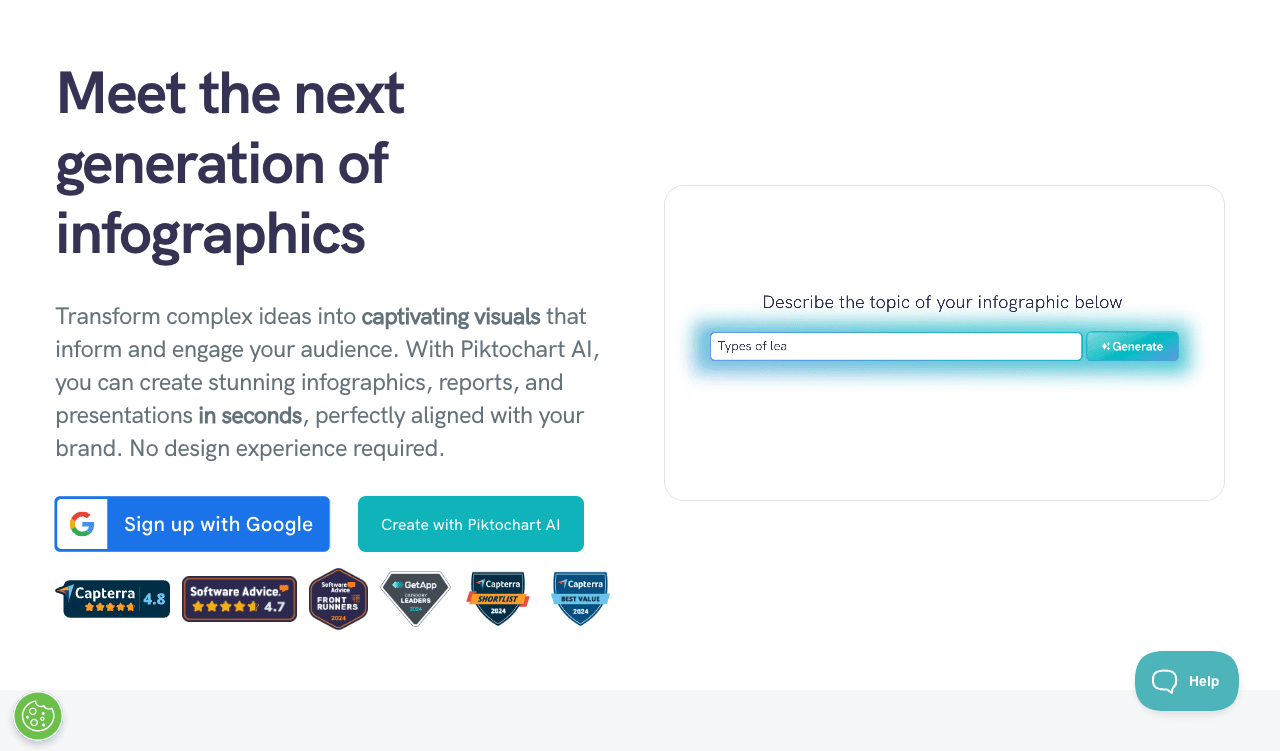
Turn text into on-brand visuals in minutes
Facts & Trust
Pricing and key facts stay visible first; expand compliance, specs, and provider details when you need deeper due diligence.
Figures above in this panel are rounded for quick orientation. Sign in for exact visits, rank breakdown, and engagement metrics.
Key Features
Shared design workspace
Piktochart keeps design reviews, feedback, and approvals in one place. Currently optimized for Web App.
Automation-ready endpoints
Rate limits and authentication are clearly documented for smooth implementation.
Tooling for engineering teams
SDKs for Other remove boilerplate and shorten the path to production.
Hands-on demos
Demo and trial environments let teams experience Piktochart before committing.
Expert Insight
Albert Schaper(Artificial Intelligence, AI Tools)
Based on 1 user review showing a 4.0/5 rating, Albert Schaper endorses Piktochart for Design use cases. Albert Schaper's background in artificial intelligence makes this assessment particularly valuable for content creators seeking Design solutions.
Pricing & Plans
Pricing: $0 – $20 / month(Updated September 2026)
Free plan $0/month (2 PNG downloads, unlimited visual projects). Pro $15/month billed monthly or $10/month billed annually. Business $20/month billed monthly or $17/month billed annually. Education $39/year, Nonprofit $60/year. Enterprise and Campus plans use custom pricing.
Usage Model: Projects, Storage — ensuring you only pay for what you actually use.
Free access to Piktochart removes barriers for content creators exploring design solutions. The free tier includes fundamental features that support basic use cases and learning. For content creators who need enterprise-grade design functionality, paid subscriptions unlock comprehensive solutions with enhanced performance and support.
Rate this Tool
User Reviews
Based on user reviews
Rating Distribution
All Reviews
No reviews yet. Be the first to share your experience!
About Piktochart
“Turn text into on-brand visuals in minutes”
Piktochart Snapshot
Key facts we track so you can judge fit before visiting the provider.
- Primary category
- Design
- Best fit
- Content Creators, Graphic Designers, Marketing Professionals +2 more
- Platforms
- Web App
- Pricing signal
- Freemium, Subscription - $0-$20 / month
- Provider context
- Piktochart - MY
- Known integrations
- Plugin/Integration
- Developer access
- API documentation, Other
- Data handling
- Global hosting
Before you choose Piktochart
- Confirm Piktochart's current limits, renewal terms, and seat pricing on the official site.
- Verify privacy, retention, and data-processing terms before using sensitive data.
- Test the integrations or API path against one real workflow before rollout.
- Make sure the supported platform matches where your team actually works.
What to verify
- Privacy policy, retention terms, and data-processing details should be checked with the provider.
Listing data is compiled from structured provider information, public signals, submissions, and periodic checks where available. Treat this page as a shortlist aid, then verify pricing, compliance, and product limits with the provider before making a business-critical decision.
How Piktochart Works
Understanding the core functionality and approach of Piktochart.
Visual design in Piktochart combines AI assistance with traditional design tools. Create layouts, illustrations, and UI components faster than manual workflows allow. Piktochart plugs into Plugin/Integration so data stays in sync.
Key Features
Explore what makes Piktochart stand out.
Shared design workspace
Piktochart keeps design reviews, feedback, and approvals in one place. Currently optimized for Web App.
Automation-ready endpoints
Rate limits and authentication are clearly documented for smooth implementation.
Tooling for engineering teams
SDKs for Other remove boilerplate and shorten the path to production.
Hands-on demos
Demo and trial environments let teams experience Piktochart before committing.
Use Cases
Discover how different audiences leverage Piktochart.
Scale content production
Creative teams stay in flow with shared workspaces and on-brand outputs.
FAQ about Piktochart
What is Piktochart and what does it do?
How much does Piktochart cost?
What platforms does Piktochart support?
How can I try Piktochart before purchasing?
What file formats does Piktochart support?
Who develops and maintains Piktochart?
How do I get access to Piktochart?
How is usage measured and billed in Piktochart?
What deployment options does Piktochart offer?
Who is Piktochart best suited for?
Compare Similar Tools
See how Piktochart stacks up against similar alternatives in the market.


Keep Piktochart's listing accurate
Providers can update product facts, pricing context, screenshots, and launch notes. Paid placements are labeled separately and do not replace editorial or data-quality review.
How to Evaluate Piktochart
Compare Piktochart with Canva, Visme, Venngage and other alternatives before you decide. The goal is not to pick the most popular product; it is to find the tool that fits your actual workflow, risk level, and budget.
- Step 1Run the demo with one real content creators task, not a sample prompt.
- Step 2Model the full monthly cost at your expected usage, including seats, limits, and overages.
- Step 3Verify the integration path with your existing stack before you commit.
- Step 4Review privacy, retention, and compliance terms before using sensitive data.
For developer teams, inspect the Other SDK. Review the API documentation for auth, rate limits, errors, and export behavior. For broader context, browse more design tools for content creators, or compare this page against the category hub. New to AI tool evaluation? Start with AI Tool Navigator.
Share Piktochart
Help others discover Piktochart by sharing it on your favorite platforms.
Report an Issue
Found incorrect information or have concerns about Piktochart? Let us know.
Need a tool shortlist for a real business use case?
Get a structured 3-5 tool recommendation, pricing comparison, and implementation roadmap for your team.
Need Help Finding the Right Tool?
Looking for alternatives to Piktochart or similar tools? Use our AI chatbot to find the right solution for your needs.