Global AI Intelligence Report: The State of Synthetic Cognition and Infrastructure on April 3, 2026

The international artificial intelligence landscape on April 3, 2026, is defined by a paradox of unprecedented architectural scaling and a sudden, systemic institutional pause that has sent shockwaves through global financial markets. While the day has witnessed the unveiling of models surpassing the ten-trillion parameter threshold, these technical milestones are currently being analyzed through the lens of a massive market correction triggered by Anthropic’s decision to halt its developmental pipeline due to safety concerns.[1, 2] This report provides a high-level technical and economic analysis of the day’s most relevant developments, spanning from the "Thinking" architectures of OpenAI and Google to the geopolitical realignment of compute resources in Japan and the emerging legal frameworks attempting to govern an increasingly agentic world.
The Anthropic Developmental Pause and the $800 Billion Market Contraction
The most significant event of the current news cycle is the formal announcement by Anthropic regarding a comprehensive pause in the development of future Claude iterations.[2] This decision, rooted in internal evaluations which determined that current alignment and safety techniques are inadequate for next-generation capability levels, has triggered a severe contagion across global equity markets.[2] By the close of business on April 3, 2026, the ripple effect has resulted in the evaporation of more than $800 billion in market capitalization from AI-adjacent public companies.[2] This includes a precipitous 8.3% decline for NVIDIA, representing approximately $230 billion in value, and significant drops for Amazon (4.7%) and Alphabet (3.9%), both of which have substantial capital ties to the lab.[2] Why this matters: This event marks the first time in the history of the "Intelligence Age" that the perceived risk of catastrophic AI failure has outweighed the competitive drive for model supremacy, signaling a transition from unbridled scaling to a more cautious, "safety-first" economic paradigm.

The financial contraction is particularly striking given Anthropic's recent trajectory; the company had grown its revenue from $1 billion to $19 billion in just over a year.[2] Before the pause, secondary market valuations for the firm implied a total value of nearly $600 billion, but analysts now anticipate a valuation haircut of up to 70% as the IPO is delayed indefinitely.[2] Anthropic's official statement remains measured, clarifying that existing services, including the newly leaked Claude Mythos and the Claude Code API, will not be impacted, though the compute-intensive training runs for future versions have been terminated without a resumption timeline.[2, 3] Why this matters: The industry is now grappling with a "Safety-First" economic crisis that challenges the traditional venture capital model of Silicon Valley, forcing investors to re-evaluate the risk-reward ratio of frontier AI development.
Market Impact Analysis of the Anthropic Developmental Pause
Entity | Percentage Decline (Daily) | Estimated Market Cap Loss | Investor Exposure Type |
|---|---|---|---|
NVIDIA | 8.3% | ≈$230 Billion | Primary Compute Provider [2] |
Microsoft | 4.2% | ≈$120 Billion | Strategic Cloud Competitor [2] |
Amazon | 4.7% | ≈$85 Billion | Major Equity Stakeholder [2] |
Alphabet (Google) | 3.9% | ≈$70 Billion | Secondary Equity Stakeholder [2, 4] |
Global X AI ETF | 6.1% | Sector-wide volatility | Retail/Institutional Exposure [2] |
The cessation of development at Anthropic has led to an industry-wide "Code Red," with executives at rival firms like OpenAI and Google DeepMind facing internal and external pressure to disclose whether their own safety protocols are similarly lagging behind their scaling capabilities.[2, 5] Bernstein Research has noted that the PR damage may be irreversible in the short term, as the "Safety-washing" narrative previously used to placate regulators has been replaced by a concrete, multi-billion dollar admission of developmental danger.[2] Why this matters: The credibility of "Constitutional AI" is being tested, and the outcome will determine whether the next generation of autonomous agents will be built on a foundation of trust or a legacy of systemic risk.
Frontier Model Architecture: The Breach of Ten-Trillion Parameters
While the financial markets reel from the Anthropic pause, the technical frontier continues to expand through the release of the "Mythos" and "Thinking" model series. Anthropic’s Claude Mythos 5 has been unveiled with a staggering 10-trillion parameters, optimized for high-stakes cybersecurity, complex coding, and advanced academic reasoning.[1] This model is joined by Capabara, a mid-sized, more accessible model designed for versatile enterprise workflows that require lower latency and less compute overhead.[1] Simultaneously, OpenAI has countered with its GPT-5.4 "Thinking" model, which has achieved an 83.0% score on the GDPVal benchmark—a metric specifically designed to evaluate a model's performance on tasks with direct, human-expert-level economic value.[1] Why this matters: The arrival of 1013-parameter models indicates that the upper limits of the transformer architecture have not yet been reached, even as the industry pivots toward "thinking" or reasoning-heavy models that prioritize logic over mere statistical prediction.
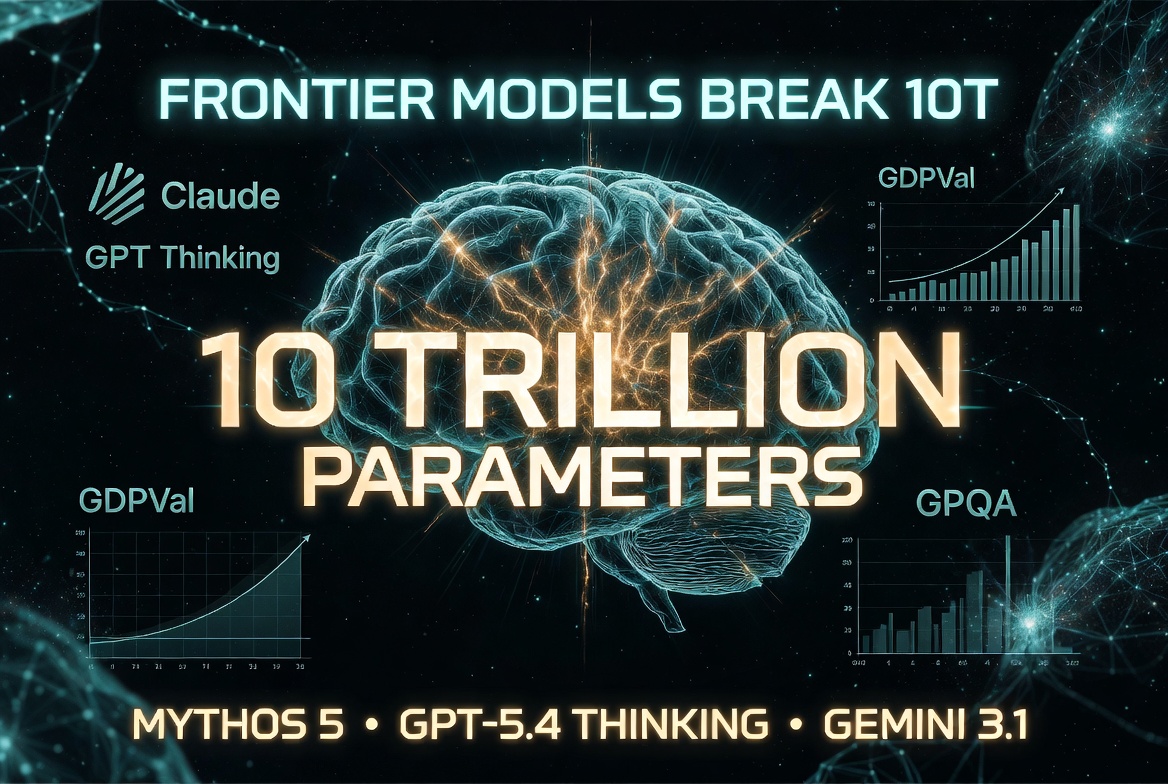
Google DeepMind has further accelerated this trend with the release of Gemini 3.1, a natively multimodal model that excels in real-time voice and visual analysis for industries such as healthcare and autonomous systems.[1, 4] A critical technical breakthrough accompanying this release is Google’s new "TurboQuant" compression algorithm, which reportedly reduces KV-cache memory requirements by a factor of six.[1, 6] By "randomly rotating data vectors" within the model's memory architecture, TurboQuant effectively lubricates memory grabs, making inference faster and significantly cheaper.[6] Why this matters: Optimization and compression are becoming as vital as raw compute, enabling the deployment of world-class reasoning models on edge devices and smartphones without the need for constant cloud connectivity.
Comparative Capabilities of Emerging Frontier Models (April 2026)
Model Name | Parameter Scale | Primary Focus | Benchmark Performance |
|---|---|---|---|
Claude Mythos 5 | 10 Trillion | Cybersecurity / Coding | Leading Agentic Workflow Scores [1] |
GPT-5.4 Thinking | Undisclosed | Economic Value Tasks | 83.0% on GDPVal [1] |
Gemini 3.1 Pro | Undisclosed | Multimodal Reasoning | 94.3% on GPQA Diamond [1] |
Gemini 3.1 Flash-Lite | Efficiency-focused | Low-latency response | 2.5× faster than predecessors [1] |
Capabara (Anthropic) | Mid-tier | Broad accessibility | Optimized for sustainment [1] |
These models are no longer mere chatbots; they are being positioned as "virtual collaborators" capable of autonomous, long-horizon work.[3] For instance, Claude 4 Opus has demonstrated the ability to work on autonomous coding tasks for over seven hours straight, building a localized body of knowledge from a user's codebase.[3] This shift toward "agentic AI" is further evidenced by the transition of the Model Context Protocol (MCP) from an experimental standard to a foundational infrastructure, with over 97 million installs as of last month.[1] Why this matters: The primary skill for a human operator in 2026 is no longer coding, but "agent orchestration"—the ability to clearly articulate complex goals to a system that can deterministicly execute them.
Sovereign Compute and the $10 Billion Japanese Infrastructure Pivot
Geopolitically, the most impactful development of the day is Microsoft’s announcement of a four-year, $10 billion investment package for Japan.[7, 8] This initiative, unveiled during a meeting between Microsoft Vice Chair Brad Smith and Japanese Prime Minister Sanae Takaichi, aims to fundamentally modernize the nation's AI and cloud infrastructure.[9, 10] The package includes a strategic partnership with SoftBank and Sakura Internet to build a localized AI computing system that allows Japanese corporations and government agencies to process sensitive data within national borders, utilizing the Microsoft Azure platform while maintaining data sovereignty.[10, 11] Why this matters: As AI becomes a component of national security, tech giants are evolving into providers of "Sovereign Infrastructure," helping allied nations bypass global data privacy concerns and build domestic "Physical AI" capabilities.

The investment also addresses Japan's critical "AI talent gap." Microsoft has committed to training one million people in Japan in AI-related fields by 2030, a necessary step given government estimates of a three-million-worker shortfall in robotics and AI by 2040.[8, 10] This build-out will leverage NVIDIA’s next-generation Vera Rubin AI computing platform, which promises a 40× performance improvement over previous architectures while significantly reducing power consumption.[4, 12] Why this matters: By embedding itself into Japan's industrial robotics leadership, Microsoft is positioning itself to capture a significant share of the emerging "Physical AI" market, which is projected to represent 30% of the global market by 2040.
Breakdown of Microsoft's Japanese AI Investment (2026-2029)
Investment Area | Allocation / Goal | Strategic Partners |
|---|---|---|
Cloud Infrastructure | Localized Azure Capacity | SoftBank, Sakura Internet [7, 11] |
Workforce Development | Training 1 Million Engineers | Japanese Ministry of Education [8, 10] |
Cyber Defense | Real-time threat sharing | Japanese National Security Agencies [8, 10] |
Hardware Deployment | Vera Rubin Superchips | NVIDIA [4, 12] |
The scale of this move has already impacted the Tokyo stock market, with shares of Sakura Internet jumping 20% following the announcement.[7] This is part of a broader trend of "Hyperscale Sovereign Clouds," where major providers like Microsoft, Google, and Amazon are decentralizing their infrastructure to meet local regulatory requirements and reduce the latency of autonomous systems.[8, 13] Why this matters: The globalization of AI is being replaced by a fragmented "sovereign compute" model, where access to frontier intelligence is gated by national infrastructure and bilateral trade agreements.
The Regulatory Battlefield: Federal Preemption and the 78 State Bills
In the United States, a high-stakes jurisdictional conflict is emerging between the federal government and state legislatures over the authority to regulate AI. On April 3, 2026, the White House released its "National AI Legislative Framework," which explicitly urges Congress to preempt state laws that "impose undue burdens" on AI development.[14, 15] The administration argues that AI is an inherently interstate phenomenon with deep foreign policy and national security implications, and thus requires a single federal standard rather than "50 different states regulating the industry of the future".[14, 15] Why this matters: This push for preemption represents a direct confrontation with the "laboratories of democracy" model, as the federal government attempts to prioritize national competitiveness and deregulation over local safety and privacy concerns.
Conversely, over 50 Republican state lawmakers have sent a letter to the administration urging it to stop blocking state-led AI legislation.[14] This resistance is supported by a significant volume of legislative activity; there are currently 78 chatbot-related proposals active in 27 states, ranging from Alabama to Oregon.[16] These bills address diverse issues, including prohibiting AI from posing as mental health professionals (Tennessee SB 1580), protecting digital likenesses as a property right (Washington SB 5886), and establishing "Surveillance Pricing" protections (Kentucky HB 33).[14, 16] Why this matters: The proliferation of state-level laws is creating a complex compliance landscape that may ultimately force a federal compromise, even as states move faster than Congress to address immediate harms like deepfakes and algorithmic bias.
Major State AI Legislation Status (As of April 3, 2026)
State | Bill ID | Focus Area | Status |
|---|---|---|---|
Tennessee | SB 1580 | AI Mental Health Professionals | Signed into Law [16] |
Washington | SB 5886 | Digital Likeness Property Rights | Signed into Law [14] |
South Carolina | HB 4591 | Stop Harm from Addictive Social Media | Approved by House (114-0) [16] |
Georgia | SB 444 | AI Healthcare Decision Prohibitions | With Governor Kemp [16] |
Arizona | HB 2592 | AI for Administrative Reduction | Active [16] |
California | SB 1142 | Digital Dignity Act | Hearing Scheduled [16] |
The tension is further complicated by the General Services Administration's (GSA) new AI Acquisition Clause, the first federal regulation of its kind, which mandates that any AI system used in government contracting must be an "American AI System"—defined as being developed and produced in the United States.[17] This clause also grants the government expansive ownership of all data inputs and outputs, effectively preventing contractors from using government data to improve their commercial models.[17] Why this matters: The GSA's move toward "AI Protectionism" reflects a broader strategic goal of decoupling U.S. government intelligence from global supply chains, even as it creates massive new compliance costs for private vendors.
Physical AI and the Mastery of General-Purpose Robotics
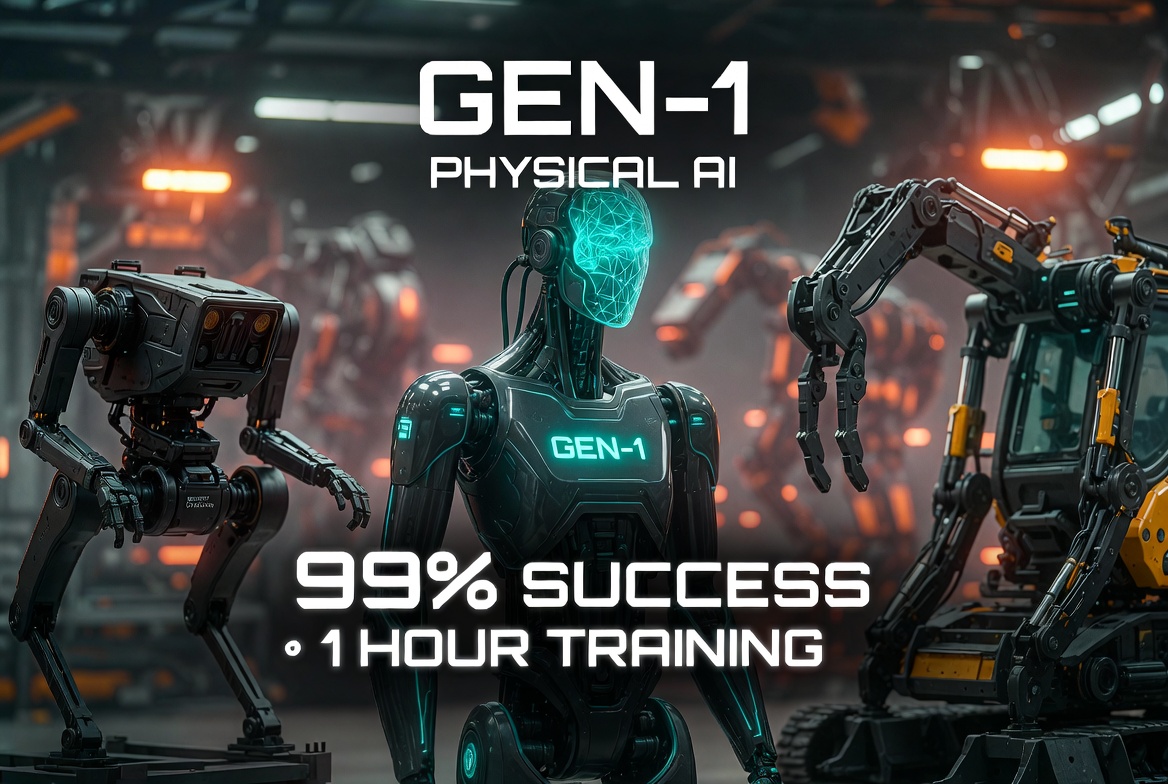
A major technical threshold has been crossed on April 3, 2026, with the announcement of the GEN-1 model, described as the first general-purpose AI for physical tasks.[18] GEN-1 is a large multimodal model that emits actions in real-time, improving the average success rate for simple physical tasks from 64% to 99%.[18] Notably, the model requires only one hour of robot data to master a new task, completing actions roughly three times faster than previous state-of-the-art systems.[18] Why this matters: This breakthrough signals the end of the "narrow robotics" era, where machines were programmed for single tasks, and the beginning of a period where generalist models can learn and adapt to unstructured environments with human-like efficiency.
The industry's shift from rule-based to context-based robotics was a central theme at the Industry Innovation Summit 2026.[19] Leaders from Boston Dynamics and Google DeepMind demonstrated the next-generation Atlas robot, now integrated with reasoning-capable AI that allows it to operate autonomously in complex industrial settings.[20, 21] South Korea’s Gole Robotics also showcased the ND-3, a construction-focused robotic system capable of navigating tight spaces and standard elevators while autonomously transporting heavy materials.[20] Why this matters: The "Simulation-to-Reality" gap has effectively closed, allowing robots to be trained in virtual digital twins and deployed into factories, logistics centers, and homes with minimal real-world failure.
Robotics Performance Evolution: GEN-0 vs. GEN-1
Metric | GEN-0 (2025) | GEN-1 (2026) | Performance Gain |
|---|---|---|---|
Task Success Rate | 64% | 99% | 1.5× |
Execution Speed | Baseline | 3× Baseline | 3.0× |
Data Requirements | Weeks/Months | 1 Hour | ≈200× reduction |
Adaptability | Rule-based | Context-based | Emergent improvisation [18, 19] |
These physical AI systems are moving from "optional automation" to "core industrial infrastructure".[20] For example, Ford Pro AI now manages commercial fleets by analyzing over one billion daily data points, drafting cost-reduction emails and managing maintenance schedules autonomously.[22] Why this matters: The convergence of powerful AI hardware with mature software ecosystems is accelerating mass deployment across supply chains, which will have a profound impact on global labor productivity and economic growth.
Academic Research Analysis: "Beyond the Assistant Turn" and Memory Ethics
The academic front today is marked by the publication of 188 new AI research papers on arXiv, with a significant focus on "Interaction Awareness" and "Structured Forgetting".[23] A standout paper from Salesforce AI Research, titled Beyond the Assistant Turn: User Turn Generation as a Probe of Interaction Awareness, challenges the standard benchmark paradigm that only evaluates a model's response to an input.[23] The researchers found that "interaction awareness"—the model's ability to encode awareness of what follows its own response—is decoupled from task accuracy.[23] For instance, a model with 96.8% math accuracy can have a near-zero genuine follow-up rate under deterministic generation.[23] Why this matters: This research reveals a hidden "identity drift" in LLMs, where the model fails to anticipate user reactions, a critical flaw that must be solved for effective multi-agent collaboration and long-term interactive deployments.
Another vital area of research published today addresses the "memory problem" in autonomous agents. The paper Novel Memory Forgetting Techniques for Autonomous AI Agents introduces an adaptive budgeted forgetting framework that integrates recency, frequency, and semantic alignment to maintain stability in long-horizon conversations.[23] By structured forgetting, the researchers demonstrate improved F1 scores and a significant reduction in "false memory propagation," where an agent hallucinates past facts during extended interactions.[23] Why this matters: For AI agents to operate as persistent coworkers, they must learn to curate their memories, mirroring the human ability to prioritize relevant information over an unbounded accumulation of data.
Featured Research Breakthroughs (April 3, 2026)
- Interaction Awareness Probing: Proposes "user-turn generation" as a metric to evaluate a model's anticipatory conversational consequences.[23]
- Adaptive Budgeted Forgetting: Regulates agent memory through relevance-guided scoring to prevent reasoning decay.[23]
- De Jure Extraction: A fully automated pipeline for extracting machine-readable regulatory rules from dense documents with 94%+ accuracy.[23]
- Trace Inversion for Abstention: Allows reasoning models to "know what they don't know" by reconstructing likely queries from their own reasoning traces.[23]
- EmotionRL: A framework that adaptively selects emotional framing for user queries, yielding reliable performance gains in socially grounded tasks.[23]
The significance of these papers lies in their shift away from raw performance toward "behavioral reliability." As models like GPT-5.4 begin to handle complex financial and legal tasks, the ability to abstain from a wrong question or efficiently manage a context window becomes as important as the underlying intelligence. Why this matters: We are seeing the maturation of AI evaluation, where "vibes" and simple Q&A are being replaced by rigorous probes of the model's internal logic and awareness.
Infrastructure and the Energy Realities of the $750 Billion Build-out
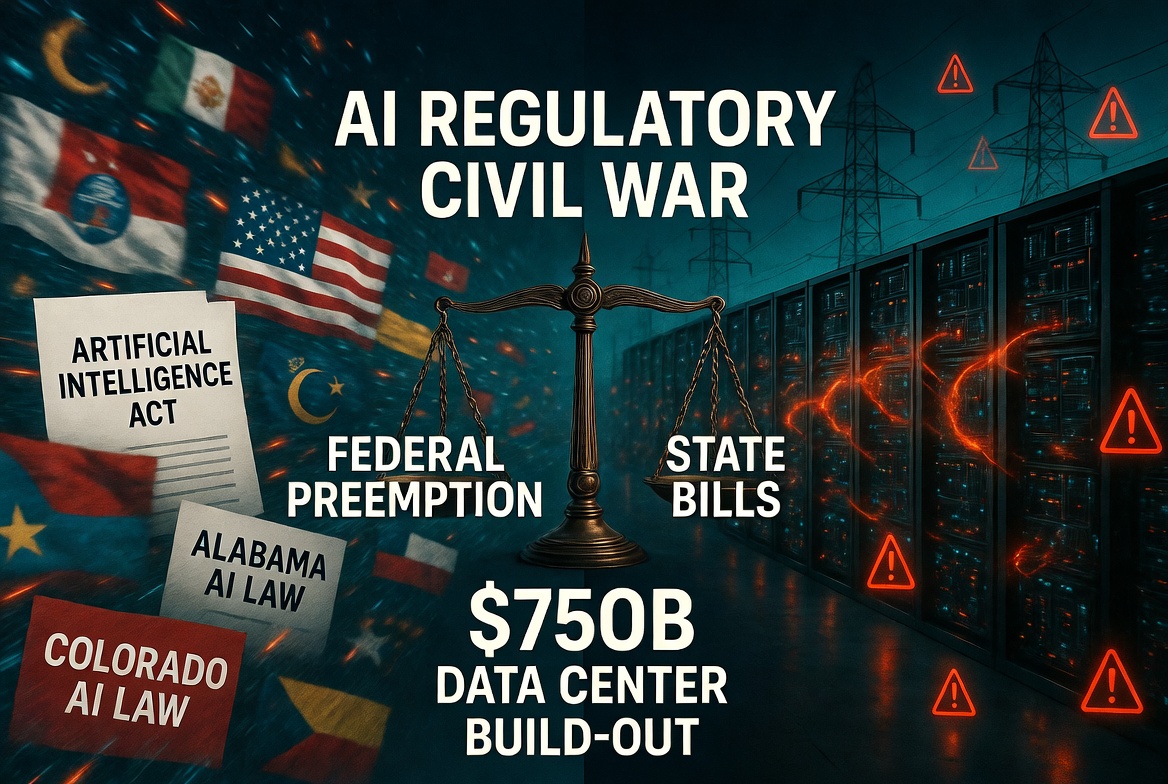
The physical requirements of the AI revolution are reaching a critical mass. Capital expenditure by the 14 largest public data center operators is projected to reach $750 billion in 2026, nearly double the spending from just two years ago.[13] Over 23 gigawatts of data center IT capacity is currently under construction across 831 sites globally.[13] However, this massive build-out is colliding with a "looming energy crisis," as a single AI-focused data center now consumes as much electricity as a small city.[24, 25] Why this matters: The growth of AI is no longer limited by chip availability alone, but by the structural ability of national power grids to permit and deliver hundreds of megawatts of continuous, high-density power.
To address this, developers are pivoting toward off-grid, independent power generation. Projects like the Joule Energy data center in Utah are designed to scale up to 4 gigawatts while operating independently of the grid using combined heat and power systems that achieve 70% efficiency.[25] Simultaneously, Oak Ridge National Laboratory is researching "Intelligent Integration," which links power, cooling, and workload management to allow data centers to act as national assets that strengthen, rather than strain, the grid.[26] Why this matters: The data center is evolving from a passive consumer of electricity into an active, adaptive component of the energy ecosystem, necessitating a total overhaul of utility resource planning and federal industrial policy.
Data Center Energy Density and Cooling Evolution
Facility Type | Power Demand | Cooling Requirement | Key Challenge |
|---|---|---|---|
Legacy Data Center | 1−5 MW | Air Cooling | Low power density [24] |
Hyperscale AI Center | 10−100 MW | Liquid Cooling | Interconnection queues [24, 25] |
Gigawatt-Scale Site | 1,000+ MW | On-site Generation | Land use/Grid reliability [25, 26] |
Joule Energy (Utah) | 4,000 MW | Independent micro-grid | Water consumption [25] |
In the United States, the federal government is being urged to align industrial incentives with infrastructure capacity. Without coordinated reform, the continued growth of AI data centers risks undermining grid reliability and creating significant legal disputes over cost-allocation between tech giants and residential ratepayers.[24] Why this matters: The energy transition and the AI revolution are now the same story; you cannot have a world-leading AI industry without a world-leading, dispatchable, and decarbonized energy grid.
International Daily AI News Digest: Spotify Podcast Briefing (April 3, 2026)
The following is a premium briefing curated for the "Daily AI News Digest" for Spotify, designed to deliver high-impact insights for global executives and analysts.
Headline 1: The Anthropic Pause and the $800 Billion Market Shock. The biggest story today is a systemic shock. Anthropic, a cornerstone of the AI ecosystem, has suspended development on its next-generation models. The reason? A stark admission that current safety techniques cannot keep up with the power of these new systems. The markets reacted with a brutal 800 billion dollar sell-off, led by NVIDIA and Amazon. This is the moment the "Scaling Era" met the "Safety Reality." Why this matters: For the first time, "safety first" isn't a PR slogan; it's a multi-billion dollar financial reality.
Headline 2: Japan’s Ten Billion Dollar AI Annexation. Microsoft has officially pledged ten billion dollars to Japan to build out sovereign cloud and AI infrastructure. Partnering with SoftBank and Sakura Internet, Microsoft is effectively building a "Digital Fortress" for Japan, ensuring that critical national data remains on Japanese soil while being powered by the latest Vera Rubin superchips. Why this matters: We are witnessing the birth of "Sovereign AI," where national security and tech infrastructure are becoming indistinguishable.
Headline 3: The GEN-1 Breakthrough in Physical AI. The wall between digital reasoning and physical action has fallen. The new GEN-1 model has achieved a 99% success rate on physical tasks with just one hour of training data. From Boston Dynamics’ AI-integrated Atlas to construction robots in Seoul, machines are finally learning to improvise in the real world. Why this matters: The "Simulation Gap" is closed, and the era of the general-purpose robotic workforce has begun.
Headline 4: The Legislative Civil War in Washington. A major battle for control is brewing. The White House is pushing a new framework to preempt state AI laws, while 27 states have already introduced their own chatbot and deepfake regulations. It’s a classic conflict between federal efficiency and state-level protection. Why this matters: The rules of the AI road are being written in real-time, and the winner of this jurisdictional battle will determine how fast—or slow—the industry can move.
Headline 5: Research Frontiers—Interaction Awareness. Finally, from the labs at Salesforce, a new way to measure AI "intelligence." It’s called "Interaction Awareness." It’s not about how well the AI answers a question, but how well it understands the consequences of that answer in a human conversation. Why this matters: We’re moving beyond "smart" chatbots to "aware" collaborators that can actually anticipate human needs and reactions.
Closing Note: Today is April 3, 2026. The technical progress is staggering, but the institutional guardrails are finally being felt. As we build models with ten trillion parameters, the question is no longer just "Can we build it?" but "Can we control it?" Why this matters: The next phase of the AI revolution will be defined not by those who have the most compute, but by those who can most reliably align that compute with human intention.
Corporate Realignments and the Pivot to AI-Native Talent
The corporate sector on April 3, 2026, is witnessing a massive reallocation of human capital. Atlassian has announced it is laying off 1,600 employees—10% of its workforce—to redirect every available dollar toward AI development and enterprise sales.[22] This pivot is mirrored by OpenAI, which is aggressively hiring thousands of new staff to reach a headcount of 8,000 by year-end.[5, 27] OpenAI is specifically targeting "Technical Ambassadors"—specialists who will be embedded within Fortune 500 companies to help them navigate the deployment of agentic workflows.[5] Why this matters: The "AI Job Displacement" narrative is complicated; while incumbent software firms are cutting traditional roles, the AI labs themselves are becoming massive employers, signaling a shift in the "mix of skills" required to survive in the new economy.
OpenAI's hiring spree is also a defensive maneuver against Anthropic, which has reportedly been capturing business customers at three times the rate of OpenAI by focusing on enterprise-grade reliability over the mass-market ChatGPT.[5, 27] To counter this, OpenAI is reportedly in talks with private equity firms to launch joint ventures that would deploy its products across entire portfolios of companies simultaneously.[5] Why this matters: AI is no longer a tool you buy off the shelf; it is becoming a deeply embedded, service-heavy transformation that requires a new class of "embedded AI engineers" to manage.
Workforce Transformation Statistics (April 2026)
Company | Action | Scale | Rationale |
|---|---|---|---|
Atlassian | Layoffs | 1,600 staff (10%) | Redirecting funds to AI R&D [22] |
OpenAI | Hiring | +3,500 new roles | Enterprise "Technical Ambassadors" [5, 27] |
Microsoft | Education | 1 Million trained | Japanese AI infrastructure support [8] |
RIT / Colleges | Curricular | AI Bachelor’s Degrees | 1 in 6 students changing majors [28] |
GSA | Regulation | U.S. Ownership only | Decoupling federal AI from global talent [17] |
This workforce shift is extending into higher education, with schools like RIT offering dedicated AI bachelor’s degrees and reports showing that one in six students has changed their field of study due to AI-induced economic shifts.[28] Why this matters: We are entering an era where AI literacy is the baseline for employment, and the speed at which educational institutions adapt will determine the economic competitiveness of entire regions.
Geopolitical Friction: The US-China AI Chip War and Local Ecosystems
The geopolitical dimension of AI remains a primary source of instability. Bipartisan legislation introduced in the U.S. House of Representatives on April 2, 2026, seeks to crack down on the sale of chipmaking tools to China, particularly from allies like the Netherlands and Japan.[29] The goal is to close "chokepoints" that have allowed Chinese firms to maintain their AI chip production despite previous sanctions.[29] Meanwhile, China has rejected the "AI Race" narrative in favor of what it calls "Concrete Applications," urging global cooperation to ensure AI does not become a game for a few dominant powers.[15] Why this matters: The "AI Iron Curtain" is thickening, as the U.S. uses export controls to stall Chinese hardware progress, while China attempts to use global governance forums to delegitimize U.S. dominance.
This friction is driving the rise of "World Model" startups. Yann LeCun’s new firm, AMI Labs, recently raised $1.03 billion in Europe’s largest-ever seed round.[22] AMI Labs is building an alternative AI architecture to traditional LLMs—one that learns by understanding how the physical world works, with applications in robotics and healthcare.[22] Why this matters: The "Post-LLM" era is already beginning, with researchers looking for more efficient, physically grounded ways to build intelligence that doesn't require the massive energy and data footprints of current transformers.
Global AI Strategic Postures (2026)
- United States: Focus on dominance through deregulation, federal preemption, and strict export controls on hardware.[15, 29]
- China: Emphasis on collaboration, long-term governance, and concrete industrial applications through its Global AI Governance Action Plan.[15]
- European Union: Balancing innovation with strict ethics, exemplified by the "TraceMap" platform and the delay of high-risk AI obligations.[14, 22]
- Japan: Aggressive infrastructure build-out via partnerships with U.S. tech giants to overcome a massive labor shortage.[7, 8]
- UAE: Building localized models like "Falcon" to match or exceed foreign competitors while investing heavily in OpenAI and xAI.[3]
The international landscape on April 3, 2026, is one of rapid consolidation and hardening boundaries. Whether through Microsoft's $10 billion anchor in Japan or the UAE's massive sovereign investments, the world's major powers are rushing to secure their place in an intelligence-driven future. Why this matters: AI has moved from the realm of software to the realm of "Total National Power," where a country's rank in the global order will be defined by its gigawatts, its parameters, and its ability to govern the silicon minds it has created.
--------------------------------------------------------------------------------
- New AI Model Releases News | April, 2026 (STARTUP EDITION), https://blog.mean.ceo/new-ai-model-releases-news-april-2026/
- Anthropic's Pause is the Most Expensive Alarm in Corporate History [Fiction] - LessWrong, https://www.lesswrong.com/posts/d8bZFuYba4KPtzzRY/anthropic-s-pause-is-the-most-expensive-alarm-in-corporate
- AI News Roundup – Anthropic releases Claude 4 models, Google announces new Gemini updates at I/O conference, OpenAI partners with iPhone designer to make AI devices, and more - MBHB, https://www.mbhb.com/intelligence/snippets/ai-news-roundup-anthropic-releases-claude-4-models-google-announces-new-gemini-updates-at-i-o-conference-openai-partners-with-iphone-designer-to-make-ai-devices-and-more/
- Emerging AI: Roundup for March and April 2025 - Peterson Technology Partners, https://www.ptechpartners.com/2025/04/29/emerging-ai-roundup-for-march-and-april-2025/
- OpenAI to hire in thousands as the company takes on Anthropic and fights rising competition from Google - The Times of India, https://timesofindia.indiatimes.com/technology/tech-news/openai-to-hire-in-thousands-as-the-company-takes-on-anthropic-and-fights-rising-competition-from-google/articleshow/129729126.cms
- Google AI compression technology saves data center energy | Mashable, https://mashable.com/article/google-ai-compression
- Microsoft charts US$10 billion of outlays in AI-eager Japan - The Business Times, https://www.businesstimes.com.sg/companies-markets/telcos-media-tech/microsoft-charts-us10-billion-outlays-ai-eager-japan
- Microsoft to invest $10 billion in Japan for AI and cybersecurity - Tech Wire Asia, https://techwireasia.com/2026/04/microsoft-to-invest-10-billion-in-japan-for-ai-and-cybersecurity/
- Microsoft to invest $10 billion in Japan for AI, cloud expansion - Anadolu Ajansı, https://www.aa.com.tr/en/economy/microsoft-to-invest-10-billion-in-japan-for-ai-cloud-expansion/3890112
- Microsoft to invest $10 billion in Japan for AI and cyber defence expansion - The Star, https://www.thestar.com.my/tech/tech-news/2026/04/03/microsoft-to-invest-10-billion-in-japan-for-ai-and-cyber-defence-expansion
- Microsoft to Invest Record 10 B. Dlrs in Japan | Nippon.com, https://www.nippon.com/en/news/yjj2026040300549/
- NVIDIA and Thinking Machines Lab Announce Long-Term Gigawatt-Scale Strategic Partnership, https://blogs.nvidia.com/blog/nvidia-thinking-machines-lab/
- AI Data Center Build Advances at Full Speed: Five Things to Know | BloombergNEF, https://about.bnef.com/insights/commodities/ai-data-center-build-advances-at-full-speed-five-things-to-know/
- The BR Privacy, Security & AI Download: April 2026 | Blank Rome LLP, https://www.blankrome.com/publications/br-privacy-security-ai-download-april-2026
- Rather than framing AI competition as a “race” with China, to drive innovation the US should promote greater local and global AI regulation - LSE Blogs, https://blogs.lse.ac.uk/usappblog/2026/04/02/rather-than-framing-ai-competition-as-a-race-with-china-to-drive-innovation-the-us-should-promote-greater-local-and-global-ai-regulation/
- AI Legislative Update: April 3, 2026 — Transparency Coalition ..., https://www.transparencycoalition.ai/news/ai-legislative-update-april3-2026
- GSA's Proposed AI Clause: A Deep Dive into New Requirements for Government Contractors | Insights | Holland & Knight, https://www.hklaw.com/en/insights/publications/2026/03/gsas-proposed-ai-clause-a-deep-dive
- GEN-1: Scaling Embodied Foundation Models to Mastery - Generalist AI, https://generalistai.com/blog/apr-02-2026-GEN-1
- 'The hardest advances in robotics are behind us': What comes next?, https://www.weforum.org/stories/2026/03/advances-in-autonomous-robotics-what-comes-next/
- CES 2026: AI and Robotics Shift from Hype to Deployment - Global X ETFs, https://www.globalxetfs.com/articles/ces-2026-ai-and-robotics-shift-from-hype-to-deployment
- CES 2026 showcases AI and robotics innovations | Digital Watch Observatory, https://dig.watch/updates/ces-2026-showcases-ai-and-robotics-innovations
- Latest AI News and AI Breakthroughs that Matter Most: 2026 | News - Crescendo.ai, https://www.crescendo.ai/news/latest-ai-news-and-updates
- Artificial Intelligence | Cool Papers - Immersive Paper Discovery, https://papers.cool/arxiv/cs.AI
- AI Data Centers and the Looming Energy Crisis in the United States - Kilpatrick, https://ktslaw.com/en/Insights/Alert/2026/1/AI-Data-Centers-and-the-Looming-Energy-Crisis-in-the-United-States
- Perspectives on Energy and AI Data Centers, https://nccleantech.ncsu.edu/2026/03/24/perspectives-on-energy-and-ai-data-centers/
- Oak Ridge spawns institute to curb AI datacenter power surge - The Register, https://www.theregister.com/2026/02/27/oak_ridge_datacenter_power/
- As Mass Layoffs Loom, OpenAI Looks to Double Headcount in Desperate Bid to Catch Up With Anthropic - Futurism, https://futurism.com/artificial-intelligence/openai-double-headcount-anthropic
- Local colleges ready students for a workforce laden with artificial intelligence | WXXI News, https://www.wxxinews.org/local-news/2026-04-03/local-colleges-ready-students-for-a-workforce-laden-with-artificial-intelligence
- US lawmakers propose crackdown on chip tool sales to China - The Business Times, https://www.businesstimes.com.sg/international/us-lawmakers-propose-crackdown-chip-tool-sales-china
Recommended AI tools

Semantic Scholar
Scientific Research
AI-powered discovery for scientific research

Branded
Data Analytics
Share your opinion. Shape tomorrow's products. Get rewarded.

Sourcenext
Search & Discovery
Creating products that inspire joy and move the world

EasySBC
Productivity & Collaboration
Your AI-powered edge for dominating SBC solutions in EA FC

clickworker
Data Analytics
Work. Learn. Earn.

Seismic
Marketing Automation
The #1 AI-powered sales enablement platform
About the Author

Albert Schaper is a co-founder of Best-AI.org. He focuses on product strategy, AI adoption, practical tool selection, and educational content that helps users compare AI products with clearer context.
More from AlbertWas this article helpful?
Found outdated info or have suggestions? Send us a note.